May 312012
 

Voice’s Alex Mitchell takes readers on a tour of Aberdeen offering a snapshot in time with regard to the appearance, condition and history of some of the city’s streets, features and buildings.

Market Street Saturday 19th May 2012:
The first sunny day for ages, so  I left the car at Union Square and went for a wander.   The handsome Archibald Simpson building (former Employment Exchange) at the north-east corner of the Market Street & Virginia Street crossroads has been stone-cleaned to useful effect.   Similarly the Tivoli on Guild Street has benefited from its restoration.

More stone-cleaning is being undertaken on the Carmelite Hotel on Trinity Street. The rectangular enclosures along Carmelite Street are now filling up with shrubs.  

Carmelite The trees planted along both sides of Rennie’s Wynd are taking hold now and doing their bit to enhance this otherwise fairly grim length of streetscape alongside the Trinity Centre car park.

Into the Green.

The shop premises formerly occupied by Coco Violet, just east of the Back Wynd stairs, remain untenanted.

Similarly the former butcher’s shop next to Correction Wynd and the large former sportswear shop on the south side.

Café 52 seems busy, but otherwise few people to be seen at 2.30 pm on a sunny Saturday.

Cafe52 The south side of the Green is already in deep shade. The Green and the surrounding area are characterised by very tall buildings and narrow streets and wynds, the unfortunate effect of which is to shut out the sunlight in the afternoons, even in the summer months.

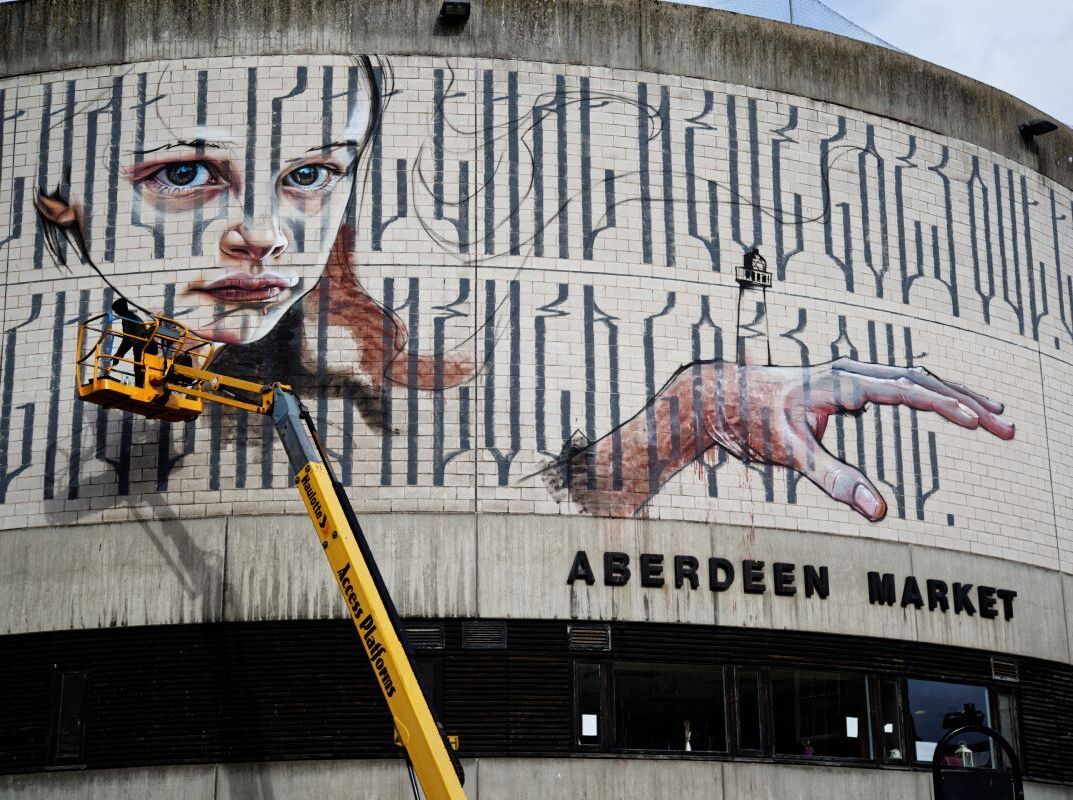
Along Hadden Street. The trees planted in the rectangular enclosures alongside the Aberdeen Market are now protected by elegant & substantial black wrought-iron tree-guards, which create a welcome impression of regularity and symmetry.

Similarly the Rox Hotel up ahead on Market Street, its 1845 Archibald Simpson premises and frontage elegantly restored.

Hadden Street But the Market Arms pub at the corner of Hadden Street & Stirling Street is looking very shabby these days.

Down Market Street and along Shiprow Lane.

On Shiprow itself, the Ibis Hotel and the huge office development beyond, apparently still unoccupied.   The lights are on, but nobody is at home.

Across Union Street and along Broad Street.   The restoration and stone-cleaning of Marischal College really show up to good effect on a sunny day and the statue of Robert Bruce is also highly effective.

The restored Marischal College has become the ‘iconic’ backdrop of choice for any TV news item about Aberdeen and it does our town credit.

Marischal2 Along Gallowgate.   The BrewDog premises in the former Marischal Bar have become something of an institution, an unusual case of a pub actually being improved by a change of ownership.

Down Littlejohn Street, across King Street and along East North Street to the Castlehill roundabout.

We lost the Timmer Market car park some time ago, to the huge disadvantage of businesses & residents in the Castlegate, and now the East North Street car park is closed down and being redeveloped as part of the new Health & Care Village on Frederick Street.

Nobody much in the Castlegate – a clutch of alkies are disporting themselves between the Sally-Ann and the Portals Bar, not doing anything particularly exceptionable, but hardly conducive to the ambiance of this historic locale or its tourist-related potential.

Marischal St. Shop Closed Down Marischal Street – a spectacularly dilapidated shoppie just up from the bridge over Virginia Street, still with its window display from about 30 years ago.   Back to Guild Street, where the forecourt of the Union Square complex seems to have become the favoured place for kids to hang out and drop litter.

Holburn Junction – the premises of the former Beluga café/bar are now occupied by a Sainsbury’s Local, directly across this end of Union Street from a Tesco Metro in the former Bank of Scotland premises.

It seems that conversion of pubs into supermarkets does not require planning permission for change-of-use, and there are a lot of redundant pubs these days.

These new small supermarkets are the one positive development in High Street shopping locales these days, being convenient of access and encouraging people to walk to their local shops and on a regular basis instead of driving to an edge-of-town superstore once a week or so.

Out the Lang Stracht to Dobbie’s Garden Centre on the western outskirts of the city.   The Garden Centre incorporates a substantial retail operation including books & magazines, leisure/outerwear – frankly, most of the togs a chap needs – plus a cafė/restaurant, delicatessen, butcher, baker etc.

Garden centres have a fairly banal image, but one can see the attractions of free & accessible parking, a clean, well-maintained environment, decently-behaved customers, clean toilets – it is easy to see the appeal compared with going into town.   And it’s somewhere to go in the car, and not too far away.

The danger is that Dobbie’s  may be the thin end of a wedge deployed to justify further retail development, followed as surely as night follows day by proposals for residential development and inexorable urban sprawl whilst retail activity continues to drain out of the city centre.

UTG2 Saturday 26th May 2012: 
Brilliantly sunny weather all this week.
Left the motor in the Denburn car park and walked down past His Majesty’s Theatre, under the Denburn Viaduct and into Union Terrace Gardens – full of people, many with small children – this is one of the very few down-town locations where kids can be allowed to run about without fear of traffic.
And not an alkie or smackheid in sight.

The 78 large mature trees are looking wonderful just now.   Every aspect pleases, other than that of the Triple Kirks, its crumbling tower & spire now further enhanced by unpainted wooden boarding to shut out the peregrine falcons which were nesting there until recently.

The peregrines are a top predator, indicative of a whole food chain of wildlife species below them.

Belmont Street is full of people, checking out the monthly Country Market.   On the brow of Schoolhill, looking towards Marischal College, where the Mitchell Tower is now conspicuously dirty-grey and unrestored.

This view of the College has been obstructed these last 40-odd years by the jumble of concrete rubbish at the Upperkirkgate end of the St Nicholas House complex – the octagonal structure, the long-redundant Post Office and the untenanted shops.   Into St Nicholas Kirkyard via Back Wynd.   Clumps of bluebells between the gravestones.   Lots of people enjoying the tranquillity.

UTG4 The anti-social element seems to have moved to the Castlegate these days.

To the Oxfam Bookshop, the last second-hand bookshop remaining in Aberdeen, where I obtained Misha Glenny’s magisterial history of the Balkans @ £3.99.

Bookshops and record shops used to be a principal attraction of town centres and High Streets, a reason for going into town, and now they’re almost all gone.  What, if anything, will replace them?

Back over Union Bridge and down through the Gardens; again, every aspect pleases – the granite balustrading, originally matching that on both sides of Union Bridge, the Tuscan-style palazzi along Union Terrace, the statues of Edward VII, a.k.a. Edward the Caresser, Rabbie Burns, Prince Albert and William Wallace, and the wonderful and truly iconic vista of His Majesty’s Theatre up there on the Viaduct.

Contributed by Alex Mitchell.

Mar 222012
 

swingchildpic With thanks to Val Sutherland.

Cash In Your Pocket, together with Homestart and the Belmont Cinema, are holding a Free Family Information & Advice Day on Friday 30th March, 9.45-2.30pm, at the Picture House, Belmont Street, Aberdeen.

The day will focus on providing help to families on matters around their finances.

This event is open to everyone with family responsibilities: parents, grandparents, carers and children – there will be something for everyone.

As well as access to advice and information from a wide range of partner organisations taking part on matters such as heating your home, savings options, benefits and keeping healthy…. and more, there will be fun for the family with free bingo, prize draws, soup packs and refreshments, free facepainting, balloons and healthy snacks for children, with the added bonus of cartoons being screened throughout the event.

We would encourage everyone to come along, to join in the fun and pick up tips on how to make the most of your money.

Val Sutherland
Cash In Your Pocket Partnership

Tel: 01224 200221
E- mail: val.sutherland@ciypp.co.uk

Mar 082012
 

The Council has taken a bit of a pasting recently, probably in Voice as much as anywhere. That’s what happens when we invite citizens to pen articles for us. One of Aberdeen Voice’s founders, Ross Cunningham, makes a welcome return by musing on some of the things that councils responsible for the city actually got right over the years.

speechpic Let’s face it, our city council is pretty woeful.
Hundreds of millions in debt, essential services cut, hair-brained schemes to revamp the city centre and deafness to those who wish to voice their opinions on the city itself.

But, was it always like this? Surely our great city’s leaders must have been competent once upon a time?

I’m sure there are many more fantastic schemes the council has facilitated over the years that I’ve left out, so please feel free to add to the list. But first try these…..

1. Raising Union Street to street level from Union Terrace to Castlegate

What a superb plan. It almost bankrupted the city when it was built in the 19th century but that was the problem of Aberdonians back then and not ours. Can you imagine having to go downhill and back up again to get from KFC to Poundland? No thank you!

2. Putting the Canal Street signpost on top of a pole instead of at street level

Brilliant! We were all tired of seeing people scoring out the C and S to formulate a crude and badly-spelled statement. To hell with delivery drivers unfamiliar to the area who may not have a TomTom to guide them. Someone needs to treat these things anally!

3. Britain In Bloom champions umpteen times

Being an ex-gardener, the floral displays in the city have always delighted me. Considering we are surrounded by grey, the colour and vibrancy the flowers provided were always a welcome sight. It looks like we may have a new place to show off our horticultural nous very soon. I’d rather we just did up the old one.

4. Revamping Marischal College

It’s amazing what you can do with a pressure washer nowadays. The granite sparkles with a freshness not seen for at least half a century – apart from the old church on the side – and it sits across the road from the recently-evacuated monstrosity. Still, the view from the never-ending queue to wait to discuss inaccuracies on your council tax bill is better than it ever has been.

5. Rebranding the city arms logo

Does anyone remember when the leopards on the city logo looked a bit too fierce and menacing? Surely not the sort of image the city would wish to portray? The answer? Make them look more like a cartoon drawn by an infant, with their tongues sticking out. Sorted.

Feb 292012
 

unionsttallpic By Bob Smith. 

Union Street-eence an elegant lady
Full o verve an flair
Nooadays she’s an aul hag
Faa’s sprootin facial hair

Biggins they war clean an bricht
Maist wi a fine granite wa
Some noo in need o a dicht
Ti wash dirt an stoor awa

Ye hid shoppies o aa descriptions
Sellin different kines o goods
Noo ye’ve git phone shops
Sellin mobiles ti flashy dudes

Fer smairt sartorial elegance
Yon Fred Watt fittit the bill
We’re left wi multi nationals
Faa’s prices wid mak ye ill

We hid bakers an grocers shops
Car showrooms showin their wares
Local baccy shops an fruit merchants
As weel as butchers sellin hares

Shopkeepers eesed aye ti keep
Pavements free o sna an ice
Ask them ti dee aat nooadays
Maist widna tak yer advice

On pavements eence bonnie an clean
There’s tabbies an chuddy aa stuck
Faith ye nivver are affa sure
Fit’s drappit amang iss muck

Biggins up abeen the shops
War clean an used as flats
Nooadays they’re dreich an worn
An mair suited for some bats

The restaurant at the Capitol
Wis famous fer its high tea
Syne ye gid throwe ti the picters
An drooled ower Sandra Dee

Setterday nichts on Union Street
Eesed ti be aa gweed fun
Noo ye’ll git a richt kickin
As yer lyin on the grun

Worst o aa noo is the traffic
The cause o noise an soss
Maist drivin doon Union Street
They jist cudna gie a toss

©Bob Smith “The Poetry Mannie” 2011

Feb 292012
 

Shakhaf Barak wrote to a friend highlighting the history behind the current referendum that is dividing the city. He has kindly allowed Voice to use it, almost verbatim as the deadline approaches for voting.

SJDUTG5 Dear Friend,
Here in Aberdeen there is a bitter referendum taking place, and it could go either way. Over 70,000 people have voted thus far, in a city of barely 212,000 souls, and both sides have reported each other to the police. Central to this story is a 250-year old city centre park, Union Terrace Gardens, and the billionaire oil tycoon seeking to redevelop it.

Union Terrace Gardens are similar to Edinburgh’s Princes Street Gardens, lying in the natural amphitheatre of the Denburn valley, the Denburn being a stream which flows right through the city, underground where it borders the Gardens. Much of Aberdeen’s best architecture was clearly envisaged to overlook this area.

The Gardens are home to a cluster of 260-year old elms trees that once formed part of the Corbie Haugh, a historic wood which ran through the valley. This is among the largest concentration of healthy mature elm trees in Europe, and they are reputed to have escaped Dutch Elm Disease, not only due to their isolation, but also because the pollution of the city has afforded some sort of protection from it.

Both the park and its beautiful Victorian toilets are Grade A-listed, and all of the trees are under preservation orders. Up until as late as 2003, the Gardens formed the centrepiece of Aberdeen’s Britain In Bloom entry, and they were truly stunning, but since then expenditure has all but ceased, and the toilets have been closed for several years.

In 2008 a local arts organisation, Peacock Visual Arts (PVA) was granted planning permission for an award-winning and sympathetically-designed arts centre to be built into the hillside of the Gardens. This would have meant felling a small number of trees but none of the elms. The design was universally acclaimed and it was hoped that this scheme would help regenerate interest in the Gardens.

Enter Sir Ian Wood, one of Scotland’s richest men, and chief of Wood Group PSN. Sir Ian decided that he’d like to redevelop the Gardens by building a five-storey bunker in their place, whilst covering over the adjoining railway line and urban dual carriageway, with the entire roof of this construction forming a flat civic square at street level. It was not entirely clear what would be installed in the bunker, although speculation was rife to say the least.

SJDUTG3 He offered the council £50m towards the cost of this project, which was mooted to cost £140m. This was possibly an optimistic figure since Union Square, a similarly sized shopping mall with none of the technical difficulties or prior excavation work, cost £250m to build. The council felt this offer was too good to refuse, but the some members of the public were up in arms.

Sir Ian decided to put the proposal out to public consultation and promised to walk away should the public reject it.

The ‘consultation’ was commissioned by Aberdeen City and Shire Economic Future (ACSEF), a publicly-funded unelected QUANGO, and conducted by The BiG Partnership, Scotland’s largest PR company.

It many ways it resembled a marketing exercise. The bulk of participation was via a website, which asked several questions with a somewhat loaded feel to them. For technical reasons, the question on whether or not to proceed with the plan defaulted to a YES vote.

If, during completion of the questionnaire, any previously-given responses were subsequently amended, this again defaulted back to a YES vote. When the results were released, it became apparent from the comments sections that may people who had intended voting NO had instead been recorded as YES voters.

Over 10,000 people participated in the consultation, and In spite of it’s technical oversights, the public voted against the Civic Square proposal by 54%-46%, a healthy and significant majority. However the PR machine kicked in and somehow spun that the 202,000 people who had not participated possibly represented a silent majority in favour of this scheme.

  Critics described it as a cross between Tellytubby Land and a skate park

Sir Ian decided not to walk away, and the project went to a council vote. The council voted in favour of taking the plan forward at the expense of PVA who by that time had 80% of their £20m funding in place. It has subsequently been alleged that some of the PVA funding was diverted into the new project.

The BiG Partnership now re-launched the plans under a new name, The City Garden Project (CGP). It was claimed that the outcome of the public consultation was that the public were broadly in favour of a garden as opposed to a civic square. Any implication that they were actually in favour of preserving the existing gardens was ignored.

The interested parties now felt that the best option was to redevelop the Gardens by building a five-storey bunker in their place whilst covering over the adjoining railway line and urban dual carriageway, with the entire roof of this construction forming a new garden at street level.

The whole thing had an air of déjà vu.

This time it was decided to hold an international design contest, paid for with public money. Six designs were shortlisted from hundreds of entrants. One, The Granite Web, bore a striking resemblance to Civic Square concept, albeit with less concrete and more greenery. Critics described it as a cross between Tellytubby Land and a skate park.

The local press heavily promoted the Granite Web design from the outset of the contest, leading with it on their front page and providing it with more photo coverage than the other designs. It was almost as though it had been ordained.

SJDUTG3 The public voted, and spoiled ballots aside, all indications were that The Winter Garden design proved the most popular. An independent poll confirmed this and put The Monolith in second place.

Tellingly both of these designs retained much of the topology of the existing Gardens. Word on the street was that The Granite Web was not a popular choice, but we’ll never know for sure, because a decision was taken not to release the results of the so-called public vote to the public.

It was then announced that the winner of the private-public vote would be put forward to the selection panel, along with another design. The self-appointed selection panel consisted of Sir Ian, some other influential people from the oil industry, an architectural consultant on the project payroll, and a councillor who backed the project.

The two designs discussed were the acknowledged public favourite, The Winter Garden, and you’ve guessed it, the joker in the pack, The Granite Web. When the panel announced the result, it should have come as no surprise to anyone that they had chosen The Granite Web, yet there was a shocked silence, and even those had come out in favour of the redevelopment initially appeared bemused if not downright confused.

The original Civic Square was mooted to cost £140m, with £50m coming from Sir Ian, £20m from the private sector, and the rest to be borrowed through a Tax Incremental Funding (TIF) scheme. Any over-run would be covered by the council (read local taxpayer) .

Only £5m of the private sector contribution has materialised thus far, but there has been an announcement that The Granite Web would be significantly less expensive to build than the previously-envisaged, but somewhat less complex, civic square. Sir Ian has offered to personally fund up to £35M of any cost over runs, should they occur.

SJDUTG7 The TIF proposal cheerfully bends all the guidelines of TIF funding. TIF is intended to be used to redevelop brownfield sites, with the loan being repaid over a 25 year period through increased rates recouped from any businesses setting up in the redeveloped area. The city council had already approved planning permission for two new industrial estates on the outskirts of town, under the business case for the TIF funding, these new estates become part of the TIF zone, so in The Granite Web’s case, sections of the TIF zone are located several miles away from the actual redeveloped area.

The predictions are for 6,500 jobs and £122m annual revenue to the local economy, all based on the new industrial estates, which have no obvious linkage to The Granite Web, operating at full capacity. Even if one were to accept that any new jobs could be somehow attributed to The Granite Web, the figure of 6,500 seems unlikely given that the London Olympics is only projected to create 3,500 jobs.

Either way, the setup feels a bit shaky; the truth is that these jobs and their associated revenue will accrue with or without The Granite Web.

By this time, councillors seemed to be getting edgy and unwilling to green-light the project, so they decided to hold a public referendum. Any group wishing to campaign was required to adhere to an £8,000 spending limit, and for this they were provided with 300 words of text in the voting pack.

The packs went out, but unfortunately some of the Retain lobby’s statements were mangled due to a ‘computer error’. The voting packs were closely followed by a big money public relations mail bombing campaign by The BiG Partnership promoting The Granite Web. Publicity materials went through every letter box, pro Granite Web articles dominated the press, and adverts were played around the clock on the local radio stations.

Apparently this expenditure was permitted by virtue of being funded by an ‘unregistered’, and as yet anonymous, campaign group – whatever that means! I guess it’s a bit like not having to pay tax because your parents never applied for a birth certificate, who knows? By this point, things were becoming surreal to say the least.

The referendum closes on 1 March and it’s a bitter fight that has divided the city. For example, an oil company boss has made a complaint to the police alleging mail hacking and cyber bullying. The police claim they are taking this allegation seriously. There have also been two arrests possibly related to claims of vote-rigging, but ultimately no one was charged.

The town has gone berserk and it’s civil war all over Facebook. It’s as if we’re all experiencing a really, really bad shared dream. I just dread to think what we’ll all be waking up to on Saturday morning.

Feb 242012
 

Peter Veritas makes the case for voting “Retain”.

1.  There is a very real danger that the City Garden Project will bankrupt Aberdeen.

item-1 The City Garden Project (CGP) is planned for a greenfield site which would require substantial excavation. It is a five acre, five storey, underground construction that would span both a main road and a railway track

It’s roof would be required to hold approximately ninety thousand tons of topsoil, the same weight as the worlds largest aircraft carrier.  It is projected to cost £140M.

Union Square, which is of a similar size, was built on a flat brownfield site with good access. The final cost was £250m.

Marischal College is a much smaller existing building that was recently renovated.  No major construction was performed.  The final cost came to £65M.

Given that context, how can we be expected the believe the estimate for The City Garden Project is realistic? Should the City Garden Project experience a similar scale of overspend to the Scottish Parliament Building or the Edinburgh trams, then the shortfall could conceivably be of the order of £360M.  The city, which is already £560M in debt, would be liable for this overspend.

It could not be rolled up into the existing loan, and would require immediate payment.  Failure to cover the overspend would result in us being left with a dirty hole in our city centre.  The only options open to the council would be to auction off it’s remaining assets, such as the other parks, to property developers, and to increase council tax  massively.  Public services which have already suffered severe cuts would be totally decimated.

2.  Aberdeen has suffered badly from previous developments.

item-2 St Nicholas House, the New Market, The Denburn dual carriageway, the Denburn Health Centre, The St Nicholas Centre, and Virginia Street are all universally acknowledged as failures that now blight our urban landscape.  Aberdeen lost many beautiful buildings to clear the way for those developments.

The people who campaigned against those architectural and planning atrocities are also campaigning against The City Garden Project.  They’ve been proven right time and time again. Perhaps it’s time we listened to them?

3.  We already voted against this Project under a different name.

item-3 There is something sinister about the City Garden Project.  It was originally conceived as the City Square Project (CSP), and envisioned as a five acre flat concrete piazza.  That proposal only emerged after Peacock Visual Arts were given planning permission to embed an unobtrusive arts centre into the hillside of Union Terrace Gardens.  Sir Ian Wood pledged £50M to build The City Square, but promised to scrap the Project if the public rejected it.

That was then put out to a flawed public consultation, in which the public voted against by a substantial majority, despite the online survey mysteriously defaulting to a “yes” vote.  Sir Ian then reneged on his promise and continued to push the concept, the council ran roughshod over the electorate, and by the casting vote of the Lord Provost, consigned the Peacock plan to the dustbin.

Sir Ian has consistently stated that he will only contribute his £50M to this particular proposal and nothing else, and that if we reject his proposal then he will divert the money to Africa.  His behaviour is baffling.

4.  There has been an air of deception around The City Garden Project.

item-4 The City Square Project was rebranded as The City Garden Project.  During the Project’s second coming the public were presented with six designs and invited to vote on them. None Of The Above was not a option.

Aesthetically, the public appeared to favour the Winter Garden design.  From a conceptual perspective The Monolith design was arguably the most cohesive.
The appointed panel then refused to release the outcome of this public vote and instead selected The Granite Web, a design for which very few people acknowledge having voted, and which many people considered to have been among the weakest.

CGP propaganda has continually claimed that Union Terrace Gardens are a dangerous place, but Grampian Police crime figures reveal that they are actually among the safest places in the city centre. Neighbouring Belmont Street, which the plans propose to connect to the Granite Web, is statistically the worst area for street crime.

Under the rules of the referendum, registered campaign groups are limited to £8k spending to maintain a level playing field.  However a mysterious group of anonymous business people has allegedly ploughed £50K into sending pro-CGP propaganda to every home in Aberdeen City.  This is not within the spirit of the referendum and is arguably a breach of the rules.

It has been claimed numerous times that the 250 year old elm trees in Union Terrace Gardens are diseased, but a recent report by a tree surgeon has given them a completely clean bill of heath.  These elms are among the last surviving in Europe, and they flourish both due to their isolation from other elms, and because the pollution of the city prevents Dutch Elm disease from spreading to them.  These trees are all covered by a preservation order.

5.  Those arguing in favour of the City Garden Project are mostly connected to it in some way.

item-5_0 Scotland’s top public relations firm were engaged to promote the Project, which may be why the majority of stories that have appeared in the local press have been fawningly in favour of the CGP.

Those who have argued the merits of the Project, both in the press and on-line, are interconnected people with an as-yet unknown agenda.

In addition to the numerous PR professionals being paid thousands of pounds each day to present the case, there are several property developers, the owners of assorted the premises on Union Street, and various oil company executives.

No fewer than three city councillors, who backed the Project, recently announced that they intend to stand down, and have also revealed that they are planning to leave the city.  Virtually all of those involved are members of Acsef, Scottish Enterprise, the Institute of Directors, and The Chamber of Commerce.  The same dozen people feature time and time again in the groups which have come out publicly in favour of the Project.  The same people wearing different hats.

6.  The economics have no basis in fact.

item-6 Tax Incremental Funding (TIF) is intended to fund the redevelopment of brownfield sites.  Businesses which later setup in and around those sites pay increased business rates which repay the cost of the development in a similar manner to a mortgage.  The business case for this Project bends the rules since the increased rates will not be gathered for the site itself, but from two new industrial estates, located several miles away and for which planning permission has already been granted.

The 6,500 jobs and £122M of projected annual revenue are a product of these new industrial estates working at full capacity. This is almost  guaranteed to occur anyway without The Granite Web.

Furthermore, the paid author of the reports is PricewaterhouseCoopers (PWC), which has recently been fined £1.4m for audit failure.  PWC rates the TIF case at Risk Level 3, where 4 is the highest risk.

7.  To save the architecture of the Denburn Valley

item-7 None of the Granite Web mockups, artists impressions, or video, have addressed the issue of the rear elevation of Belmont Street.

This is home to some of Aberdeen’s most spectacular architecture, descending right down to the level of Denburn Road.  Architecture which will be obliterated when the CGP connects to it, some five storeys further up.

Most of these buildings are either local businesses or publicly owned concerns, and several of them have picturesque balconies below the finished level of The Granite Web.

8.  To retain our sheltered park.

item-8 Union Terrace Gardens lie in the Denburn Valley which offers shelter from the wind and urban pollution.  Raising the area up to street level would turn it into a wind trap.

The wind would howl round the concrete walkways and other architectural features of the granite web, plants would struggle to survive, and people would avoid the area, preferring instead to travel along the relatively sheltered confines of nearby streets. It’s a fallacy to claim that this development would enhance connectivity.

9.  Union Terrace Gardens have been cynically starved of funding – in order to ‘pave the way’ for this redevelopment.

item-9 Union Terrace Gardens was the centre piece of Aberdeen’s famous successes in the Britain in Bloom contest.  Over the course of the past eight years the council has cut funding, with the result that the Gardens are no longer maintained at previous award-winning levels

The beautiful Grade A listed public toilets were closed, the famous giant draught boards were ripped out, the winter skating rink was no longer installed and concerts and other public events were discontinued

A modest investment would both regenerate the Gardens, and improve access to them.  There is no need to risk bankrupting the city for what amounts to no additional benefit

10.  The curse of Corbie Haugh.

item-10 Back in the seventeenth century, the area where the Gardens now stand was a wood called Corbie Haugh. The ancient Scots word for crow is corbie and the wood was named after the crows which gathered in the grassy valley and within the bank of elm trees. The elm trees in the Gardens date back over 250 years to that eighteenth century wood.

An ancient legend, The Curse of Corbie Haugh, holds that when the crows depart, the city will be ruined. If the elms are chopped down, the crows will indeed depart, and if they city ends up burdened by an additional £360m of debt, then it shall indeed be ruined!

SAVE OUR CITY FROM DISASTER BY VOTING TO RETAIN UNION TERRACE GARDENS.

  item-12 item-13

Feb 242012
 

By Mike Shepherd.

UTG Enjoyed by Aberdeen Public

The polling cards are out for the Union Terrace Gardens referendum and you have until March 1 to vote. The hype means you’ll have been bombarded with leaflets, pamphlets, news items and radio adverts.
If ‘connectivity’, a ‘21st century contemporary garden’, or ‘street-level access’ are key factors in deciding your vote, look no further; vote for the City Garden Project.

If you are undecided or swithering then read these very good reasons for voting to retain Union Terrace Gardens. 

1. Your vote will preserve the look and feel of the Granite City. Union Terrace Gardens are an integral part of the heritage of Aberdeen. Planned by the same architects who designed the Art Gallery and the frontage of Marischal College, they show an architectural harmony in the city centre which would be destroyed by a modernistic City Garden.

2. Your vote will not result in a ghastly modern structure replacing our park. Although described as the City Garden, it is in fact a mixture of buildings, flyovers, underpasses and parkland. The design has a passing resemblance to 1960s-style new town architecture. At one public meeting, someone said that the underpasses in particular were likely to end up as urban no-go areas. I have even heard a supporter of the scheme conceding that it will look dated after about five to ten years.

3. Your vote will stop a multitude of new glass box office blocks being built in the city centre. Council documents show that consideration has been given to plans to build a central business district in the city centre and encourage office block construction. The building of the City Garden Project, “will encourage development in the city centre sooner, and on a bigger scale, than might otherwise be the case without public investment in enabling infrastructure.”

4. Your vote will improve our much-loved park. Jimmy Milne, oilman and MD of Balmoral Group, has said:

“I and many of my business contemporaries, are committed to establishing a fund which will help bring the gardens back to their former glory. Without destroying our heritage, and without putting Aberdeen City further into debt, it would not be difficult to breathe fresh life into the park. Improved access, new planting, cleaning and restoration, park wardens and live events could all be relatively easily and cost effectively achieved.”

5. Your vote will ensure that the mature trees in Union Terrace Gardens will be saved. All 77 trees will be kept, including the twelve elms, some of which are at least 200 years old.

6. Your vote will stop our Council borrowing £70m they can’t afford. Aberdeen City Council, £562m in debt, is being asked to borrow £70m through a risky tax scheme to help fund the City Garden Project. If there is insufficient money to pay back the loan, Council funds will be required to service it.

7. Your vote will avoid significant disruption and pollution in the city centre for the near three years it will take to build the scheme. The technical feasibility study for the project estimates that the equivalent of 3,947 dump trucks of earth and 4,605 dump trucks of granite will be excavated from the Gardens causing ‘large environmental impacts from noise, transport, dust and energy use.’

8. Your vote will avoid the major traffic problems caused by the movement of heavy lifting equipment, dumper trucks and lorries in and out of the city centre. It is estimated that the City Garden will take almost three years to build. It is likely that there will be major traffic problems in the city for much of this time. City centre business will be impacted by this and may never recover.

9. Your vote will avoid much, if not all, of the Council’s cultural activities being displaced to the underground building in the City Garden. The council funds institutions occupying cosy, intimate venues such as the Music Hall, Lemon Tree and Belmont Cinema. A review of council-funded cultural activities will be made with a view to possible relocation to the underground concourse.

10. Your vote will avoid any consideration that the future of the HM Theatre could be in doubt. Two major performance venues will be built in the City Garden only yards from HM Theatre. Councillors have asked if this will have an impact on the future of HM Theatre. No specific assurances have been given.

Aberdeen could change forever if the City Garden is built, and probably not for the better.

We have the chance to keep the leafy, green heart of the Granite City. 

VOTE: RETAIN UNION TERRACE GARDENS

Feb 222012
 

Almost every time Karin Flavill looks at the design for the Granite Web, the same question comes to mind. “What would Howard Roark think?” Intrigued? Read on.

utgbelmontpic

Howard Roark is the hero of The Fountainhead, a novel by Ayn Rand.

Rand is a controversial writer; aspects of her objectivist philosophy were transported across the Atlantic decades ago and transformed into what we call Thatcherism, so it’s safe to say that she draws strong opinion, from those who have heard of her, both here and in the US.

The attraction of The Fountainhead for me was that it gave me a glimpse into the unknown, that a philosophy designed to help the wealthiest members of society feel not simply financially superior to those who struggle, helps them feel morally superior to them too.

What is it that tyrants see that allows them to derive a sense of well-being when they look in the mirror? Reading Rand can help you find out, even if it’s unlikely that in reality, many of society’s bullies and elitists have the personal qualities and ethics Rand depicts in her heroes.

Roark may be a more interesting and relevant reference point than some other fictional characters who have entered the Granite Web versus Union Terrace Gardens debate. Jake the Ghost and Morris the Monkey for example, as promoted by the BIG Partnership, seem to have a peculiar and hopefully incorrect impression of what moves Aberdonians to vote.

Roark is his own man, and is Rand’s idea of the Perfect Man. A gifted and original architect, loathed by the majority for his innovation and commitment to the future, he despises architecture which draws irrelevantly from the past. His designs are modernistic and often hard for people to understand. The few who do understand become his friends, and are held up to the reader as exemplary beings.

In some ways, Howard Roark would seem to be another ideal spokesperson for the City Garden Project. On the other hand, this objectivist hero’s deepest contempt would be reserved not for those who disliked his designs, but for that partnership between business and government which is so conducive in the long run to crony capitalism. Hello, ACSEF.

  The pro-Union Terrace Gardens lobby regards the existing Gardens as a unique prize which could be something magical

Leaving the politics aside for a moment, would Roark look at the design and love it? I don’t know. I’m not an expert on architecture, but I do know a little more about people, and about conflict, and about the factors causing people beginning to feel alienated in their own city. Such doubts seem to be at the heart of this debate.

The pro-Granite Web lobby feels that Aberdeen requires a drastic makeover for it to become a place they would want to continue living in and that others would want to move to. The pro-Union Terrace Gardens lobby regards the existing Gardens as a unique prize which could be something magical if only people who understood it were listened to. The original Peacock Visual Arts design symbolises what could have been.

Throughout The Fountainhead, examples and analyses of the character’s genius as an architect are provided. One passage is, for me, particularly telling. Self-made man Mr Mundy has heard that Roark is a great architect, and would like Roark to design a house for him. Roark meets with him to ascertain what kind of man he is and subsequently what kind of house he would be happiest in.

“There was a place,” said Mr Mundy, “Down there near my home town. The mansion of the whole county. The Randolph place. An old plantation house, as they don’t build them any more. I used to deliver things there sometimes, at the back door.”

He goes on to describe the ways in which he would like to recreate that dream house, the house of his aspirations. From what we already know of Roark, he would dislike the notion of recreating something from the past. However, that’s not at the root of his disapproval of Mr Mundy’s aspirations. This is:

“It’s a monument you want to build, but not to yourself. Not to your life or your own achievement. To other people. To their supremacy over you. You’re not challenging that supremacy, you’re immortalizing it….Will you be happy if you seal yourself forever in that borrowed shape?…You don’t want the Randolph place. You want what it stood for.”

In other words, it’s not simply technical skill, the vision of the artist and the ability to give the client what he wants that makes Roark a great architect. He sees who people are, not as they want to be seen, or as they try to be seen, but as they are. It’s this ability to look past the hype, the pretence, self-advertising and PR that enables Roark to build houses in which people can feel truly at home.

Think of your own dream house. Would it be one that somebody else had designed? A talented design team who would create something that was a compromise between their personal tastes and your picture of who you would like to be? Who furnished it in accordance with those same principles? Would it be your home, or would it be a design piece reflecting aspirations of who you wish you were, rather than who you really are?

  Who are we, in Aberdeen? A conflict like this forces us to consider that question in some depth

The promotional video for the Granite Web presents a futuristic world peopled with white, transparent figures ambling aimlessly through flower beds, staring uncomprehendingly at car parts dangling from a roof, drinking coffee. Observe, consume, observe and consume.

These transparent figures aren’t creators or innovators. They simply absorb, passively, that which has been transported from elsewhere to make the city seem more impressive to outsiders. A place that might, at some future date, be awarded City of Culture status!

The promotional literature keeps insisting that this will be the people’s park. It encourages readers to imagine themselves consuming all that the park has to offer, in the belief that this will result in them achieving a sense of ownership over it. There will, we’re promised, be spontaneous performances, but it’s not clear who will provide these. Perhaps musicians drafted in from outside.

Who are we, in Aberdeen? A conflict like this forces us to consider that question in some depth. My impression, living here, has always been that Aberdonians tend towards reserve, despite night-time scenes on Union Street when alcohol loosens inhibitions. The notion that we can buy a totally different character for Aberdeen, via an expensive raised park, seems dubious at best.

Union Terrace Gardens exemplifies the typically reserved nature of the Aberdonian. Like a Christmas tree that contains only a few, semi-concealed fairy lights, it is capable of emitting the magical quality that a garishly decorated tree cannot. The magic of mystery and discovery, and something very different from the usual variation on the iconic city centre park that is springing up all over the world.

One person’s iconic, radical, inspirational park is another person’s pretentious vision of future dystopia. I’ll admit I belong to the latter category, which is why I’ve already voted to retain, and improve, Union Terrace Gardens. Peacock Visual Arts was a local initiative which would have provided a place where people interested not just in consuming the arts but in contributing actively to them could have congregated. That was an exciting notion.

The Granite Web, on the other hand, constitutes yet another ‘space’ in which the people who live here may perform a passive consumer role.
Sir Ian Wood believes that he is giving Aberdeen a gift, and has expressed hurt that many in the city fail to appreciate this. The difficulty is that altruism doesn’t always create a sense of self respect in the recipient.

The price paid for that altruism is that the opportunity to create and innovate is taken away from people in the community, limiting their opportunity to participate to that of being passive consumers. For some, regardless of the risk of being branded ingrates, that may be too high a price for them to enter voluntarily into this particular contract.

Feb 222012
 

Aberdeen is a city on a downward slide. That makes for uncomfortable reading, doesn’t it? Our gut instinct, being the proud city we are, is to reject this notion out of hand, though deep down we all know it is true, says Graeme Campbell.

giveutgpic The cause of the rot is not easy to identify. Opinions will differ and any debate would most likely be fierce. It is perhaps best to say the gradual slip in the condition of our once grand and glorious city can be pigeon-holed to two vague categories – poor planning and the slow decline of the energy sector.
Or perhaps over-dependence on it? Two and a half pigeon holes then.

So, avoiding any unhelpful debate surrounding the way we arrived at this point, we must as a city look forward to the best possible route to a future of prosperity. We must look for a plan to return grandeur and pride to the Granite City. 

Our carefully-selected councillors, together with possibly our most successful loon, Sir Ian Wood and the private partnership Aberdeen City and Shire Economic Futures (ACSEF) think the solution to the gradual slip is a new garden. Not exclusively a garden you understand, but a garden with conferencing facilities and a café. To give all credit due, the plans certainly are impressive and whilst perhaps not so impressive in keeping with the architectural fabric of the city, we are, of course, a city not afraid of change.

In the most recent release posted through all city letterboxes, Aberdonians are directed by a host of interested parties to the key point, “You deserve it!” Well yes, most likely. But oddly, relegated to fifth, is what will be the key point for most Aberdonians. Once again we don’t want to admit this but we’re all thinking it, “We can afford it”.

Will Aberdeen City be pushed to the very brink of bankruptcy by this plan, as happened when the city took the bold decision, so long ago, to construct our now famous Union Street granite mile? Probably not. Of course, Sir Ian’s mammoth oil wealth will go some way to meeting the cost of development on the site – and only on this site, he has been quite clear on that point – the further estimated £100m will come from business rates, council tax – of course – and the heinously-complex Scottish Governmental TIF funding mechanism.

Now nobody wishes to be bored to tears by the inane workings of a TIF, so let’s not worry about that. Instead, let’s find out what other places are using TIF to create.

  • North Lanarkshire plans to spend £73m to transform the former Ravenscraig steel site, an area of quite unrivalled deprivation, to the benefit of the many people who live in the area.
  • Argyll and Bute is to extend the North Pier at Oban for £20m, further securing the town’s position as Gateway to the Islands, a major boon to the tourist industry no doubt.
  • Falkirk plans to use its TIF in a far less grand manner, by bringing about strategic road developments and improving the flood defences. Clearly a sound decision.

But the plans which should be of most interest to any outward-looking Aberdonian comfortably seated in Europe’s oil capital, come from Fife. The council there is to spend its modest £17m TIF improving vehicle and marine access to the already-thriving Energy Park Fife, where renewables are already being constructed. I know, that’s not oil, but it is very real, so let’s not sneer. Not content with this, Fife has also begun construction of the Levenmouth Low Carbon Investment Park which is set to become ‘Scotland’s foremost energy park’.

Whilst in Aberdeen we plan to spend £150m on a garden and café.

Is anyone else embarrassed? Our great city, the economic powerhouse of Scotland, is being distracted by plants and trees whilst other towns are going green in a wholly more financially-sound way. This city has the engineering and science skills, brought by the oil industry and our two modern and diverse universities, to become a world leader in the renewables field.

You don’t need to do the math to know a research and development centre, alongside a manufacturing park would be of significantly greater financial gain to the city than the redevelopment of a garden.

This brings us to the question – has the Council considered this? Understandably, Sir Ian may not be keen, but this is about so much more than the oil empires held by the few; this is about the continuing prosperity of the many.

So, as the ballot papers find their way to you, look around the city. Look for the signs of the rot brought about by poor management by those who, for too long, have only looked inwards – decision makers enjoying the security of the formerly-booming local oil industry.

Consider what the world, given the current environmental and economic climate, would look to Aberdeen for. Horticultural tips? A show in our new 5000-seat outdoor amphitheatre? Or will they look to Europe’s ENERGY Capital to lead the way to a bright new future of renewable energy? And then, as our city leads the world in technological advancement in the renewables field we will look forward to investment, to jobs and to success.

When the ballot paper lands on your doormat, consider what Aberdonians truly deserve and ensure your vote lets our council know just what you want for your future.

Feb 172012
 

A lecture by Charles Renfro, held at the Robert Gordon University, Tuesday the 14th of January. By Jeremy Millar.

utgehibitionpic I pulled on my black turtleneck and picked up my Mac book pro and set off for the lecture. Would I be mistaken for an architect; yes I was – it’s all in the attention to detail. The theatre was pretty full, with architecture students to the back, and bolder interested parties to the front. Charles Renfro is an engaging character – think Niles Crane amalgamated with Andy Warhol.

He had flown in especially for this event, and encountered the usual techie difficulties in getting his gleaming Mac book pro to talk with a PC campus. The lecture was a run through of a number of the DS+R projects, and very impressive it was too.

At their heart DS+R are artists, often very clever and imaginative conceptual artists. This approach is exemplified by the ‘blur’ installation on lake Neuchatel in Switzerland. This brought to mind ‘Smoke on the Water’ for some reason. This building was a folly in the architectural sense and Charles spoke of playing with the senses as the visitor entered the water cloud and saw nothing. Like many of the DS+R projects there is an element of passing through, rather than destination.

The revolving trees in Liverpool are another witty play on perception.

Understandably the main focus of the lecture was on the High Line project in New York. I have to say that I was a fan before, and now I am even more so. This project demonstrates all that is great about urban design. It involves people with their environment on so many levels. There are many small spaces along the route that offer opportunity for performance. There is a sense of people owning and playing up to the intimacy of these spaces. If it is not to your taste – well you can just move on. It was, however, sooo New York – and I was reminded of “just a New York conversation rattling in my head”: thanks Lou.

 a walk-through video that involved much playing of the bagpipes

I was impressed by the way in which the High Line acknowledges routes and roots, and builds in memory of decay and goes wild. Charles is keen on letting the DNA show through and inform the evolution of the space. He ably demonstrated this with the Lincoln Centre and the new Rio gallery designs.

Loving what I’ve seen so far, in that it is visionary, interactive and accessible.  These projects are also all in large metropolises with sophisticated urban elites, and large numbers of tourists pretty much the year round. There is no question that I would visit if in New York, Rio or Boston.

And so onto the ‘City Garden Project’ for which Charles launched a walk-through video that involved much playing of the bagpipes. The key words and phrases included diversity of ecology, ideas pulled from existing context (that DNA concept) sustainability, green lung, reconnecting the city, reinforcing heritage moments, keeping topographic interest; and I have to say he lost me.

I could see some of the connections to the successful DS+R projects, but this vision betrayed a fundamental absence of an understanding of what makes Aberdeen unique both architecturally and culturally. The DNA of Aberdeen city centre is in the crisp Victorian lines of squares, crescents and terraces. The grand public buildings echo a past of commerce and culture as one strolls down Union Street.

The visual dominance of ‘education, salvation and damnation’ overlooking the gardens and leading the eye round to the gallery are rightly flagged up in guides to the city.

The gardens as they stand reveal this DNA and tell Aberdeen’s story. Charles in his presentation showed photographs of this evolution, the exposed Denburn, the trains pulling into the station, the bandstand and the vistas beyond. This legacy would be obliterated, and as for the DNA, we would have some balustrade and two statutes. I would defy any visitor to read the city from the perspective of the Web, unlike the active interpretation gained from a stroll along the High Line.

A question about the merits of consultation with the public gained an acknowledging that this had not happened

Granite is what makes Aberdeen noteworthy. The city centre is a symphony of granite. Apart from the granite in the name of the Granite Web it barely features in the design. The talk of the eye being drawn to new perspectives is compromised by the edifice of the Web blocking views towards the Theatre and the Terrace. The parade of arches under Union Terrace barely feature in the walk through.

The biodiversity of the various garden spaces are for me messy and confused. The High Line took it’s planting from the wild flowers that colonized the derelict line and the wildness was utilized to great effect. The current gardens are formal with wild edges and they reflect a city rightly famed for this form of planting. If people want to experience the Scot’s pine they can catch a bus to the Duthie Park. We have parks for all tastes and occasions in Aberdeen. There is no need to create a microcosm of the northeast in the city centre.

There was time for a few questions. A question about the merits of consultation with the public gained an acknowledging that this had not happened, although there was an awareness of the controversy. DS+R worked to the brief and they may consult more widely if the referendum is successful. There was no acknowledgment of contact with heritage groups at any stage of the process. Charles has made four visits to the city and feels he is getting to know it.

A question about the profile and presence of the arena space referred to as the ‘butterfly’ draws on the restaurant at the Lincoln centre, and both attempts to sit in the landscape and be iconic. There was an acknowledgement from Charles that this is a work in progress and they will get it perfect.

There was a question about sustainable build and climate change. Charles said that the build will reach the highest standard and will probably be the first in Scotland to do so. He talked to the advantages of green roofs for maintaining ambient temperatures. He did not address the concrete involved in the build, but did say that he was given materials to work with.

A further query focused on the tunnel through to the station. Charles was clear that this is not part of the project, but the Web would provide the opportunities for others to take these developments forwards. The man from Keppie spoke of connecting with the harbour and opening access to Aberdeen’s other areas in 10, 20, 30 years. He added that the project is about creating an identity for Aberdeen going forward.

 Make Union Street a cultural space and preserve the gardens

A question followed which addressed scale of the design and queried the numbers of people required to make the space work. The observation that Aberdeen was not New York was made.

Charles interestingly responded by reference to walking on Union Street and having to ‘fight’ people off. He went on to claim that the Web would provide the space for people to escape Union Street, which he acknowledged was dying, with the malls draining the energy away.

He then went on to claim that a range of cultural programming would attract people to the Web. It would be a melting pot for all the different populations that are around. In a further observation about walking down Union Street in the rain, he wondered why the ‘sidewalks’ couldn’t be bigger.

The final question was the magical one, and asked Charles that knowing what he knows now and if given a free rein to develop a project – would he go for the current one? The answer was of course, absolutely. He then returned to his battling down Union Street theme and made the obligatory one man and his dog in the gardens observation of the usage of the gardens by the public.

So there you have it. For me the most revealing evidence from Charles came with his ‘Why can’t the sidewalks be bigger’. In looking into the tranquil sanctuary of the gardens from the bustle of Union Street he was blind to the answer beneath his feet. Pedestrianise Union Street: create a space, a green corridor that revitalizes the Street; brings together all the successful elements of his other projects, preserves and lets the DNA speak. Make the Street a cultural space and preserve the gardens – subject to access improvements and recreational attractions – as the sanctuary within the hustle and bustle of ‘downtown’ Aberdeen.

The final train journey along the High Line delivered turkeys to New York for Thanksgiving.

Don’t let the City Garden Project deliver another architectural turkey to Aberdeen. Vote ‘Retain Union Terrace Gardens’  in the referendum.  

Cue ‘Won’t Get Fooled Again’…