May 212013
 

With thanks to Doug Haywood.

cid_0608867c-b5a1-47a2-8667-b1f88f216d38 The Aberdeen Radical Independence Campaign (RIC) will be holding a People’s Assembly in the Foyer from 1.00 p.m. to 5.00 p.m. on Saturday 25th May.

This is a chance for people to come together, share ideas, ask questions and discuss the kind of Scotland that we want to build.

The event is free and speakers will include John Finnie MSP, Susan Archibald the Disability Rights Campaigner, Maggie Chapman a Green Party Councillor, Jill from Aberdeen Against Austerity and Euan Benzie from the local RIC group.

Aberdeen RIC was set up following the national Radical Independence Conference in November last year which agreed a Declaration that is explicit about what we need for the citizens of Scotland.

The UK is the 4th most unequal country in the developed world.   Alistair Darling, head of the NO campaign has said that Labour will cut “tougher and deeper” than Thatcher.  No matter who is in power in Westminster, a fairer society will not be on their agenda and the worst of the austerity cuts are still to come.

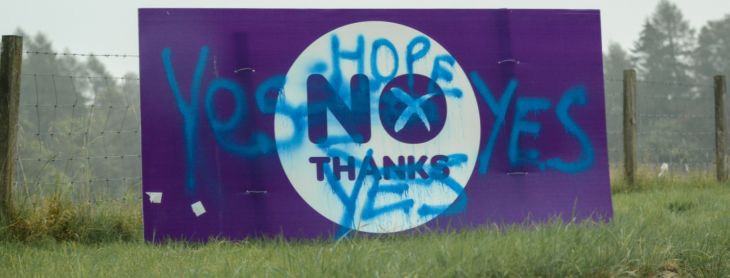
A YES vote in 2014 is the first step towards a fairer Scotland.  This is not just a campaign for independence but a campaign for a better Scotland which we believe can only begin with independence.

We are tired of complaining about Britain – it is time to talk about what Scotland can be.

Scotland can be a participative democracy.

  • Where no-one’s view is worth more because they have money.
  • Where financial interests don’t drown out the voices of the people.
  • Where decision-making belongs to the many and not just an elite.
  • Where communities are not told what they will be given but decide what they need.
  • Where our institutions are reformed to include the people in their governance.
  • Where the media is balanced, education creates active citizens and information is free to all.

Scotland can be a society of equality.

  • Where poverty is not accepted.
  • Where pay gaps are small and poverty wages are ended.
  • Where tax redistributes wealth.
  • Where no human attribute is a justification for discrimination and prejudice. Where human rights are universal.

Scotland can be a just economy. 

  • Where profit never justifies damaging people and the environment.
  • Where essential industries are owned by all and not exploited by the few.
  • Where workers have the right to fair treatment and to defend themselves.
  • Where industrial democracy makes better businesses.
  • Where investment is for development, not for speculation.

Scotland can be a great welfare state.

  • Where the social contract is not between the state and the people but between the people themselves.
  • Where from cradle to grave society cares for all regardless.
  • Where delivering more and better social services is the national priority, not austerity.
  • Where the government of the people is never used to create private wealth.

Scotland can be a good neighbour.

  • Where we seek to work with nations around the world to resolve global inequality, climate change and conflict.
  • Where we never join international alliances for exploitation and war.
  • Where we work to reform and democratise multinational institutions.
  • Where we see our deeds, our national culture and our values as a message of hope.

Scotland can be a moral nation.

  • Where mutuality, cooperation and fellowship define our relationships.
  • Where we are good stewards of our country and hand it on to the next generation in a better state than we inherit it.
  • Where our values are not dominated by greed, selfishness and disregard for others but by patience, generosity, creativity, peacefulness and a determination to be better.

This is a Scotland which British politics has robbed from the Scottish people.  We want it back!

Our future is unknown, which is good.  Only in uncertainty can hope and possibility prosper.

We choose the chance to fight for a better Scotland; we reject the offer to endure more of the same indefinitely. We are socialists, feminists, trade unionists, greens. We are from the peace movement, from anti-poverty campaigns, from anti-racists groups. We are community activists, civil liberty campaigners, the equalities movement and more.

This is going to be a lively afternoon and we hope that as many people as possible will come to ask questions and contribute to the conversation.

The Aberdeen People’s Assembly is being held in:

The Foyer,
Marywell Centre,
Marywell Street,
Saturday 25th May.
1.00 p.m. to 5.00 p.m. 

For more information check out our Facebook page at https://www.facebook.com/groups/AberdeenRIC/ or telephone 07813 085896.

Comments enabled – see comments box below. Note, all comments will be moderated.

Apr 262013
 

better-together With thanks to Kathryn Russell.

Better Together Aberdeen, part of the pro-UK Better Together campaign, was launched yesterday, Thursday 25 April by Aberdeen’s own world-renowned scientist Professor Hugh Pennington at Aberdeen’s Park Inn Hotel.

This important event in the campaign for Scotland’s future featured North East MSPs and local business and community leaders.

Ahead of the meeting, Professor Pennington said,

“I am delighted to be launching the local Better Together group in Aberdeen. The meeting will be a chance for people to find out how they can get involved in the campaign for a strong Scotland in the UK.

Richard Baker MSP, Better Together Director, said,

“Now that we know the date of the referendum, Better Together are stepping up our campaign. The response we have been getting in Aberdeen has been fantastic; so many local people have expressed their support and wish to remain in the UK. This launch is a chance for local people to get involved in the campaign for a strong Scotland in the UK, regardless of campaigning experience.

Daniel O’Malley, a youth member of Better Together Aberdeen, added,

“In September 2014 Scots will make the biggest political decision of our lives. Better Together Aberdeen will campaign hard to ensure that local people have the facts to make this decision. We’re looking forward to talking to residents about what separation would mean and signing up more local people to our campaign.  Whether you’ve campaigned before or not; if you believe Scotland is stronger as a part of the UK – we need you.”

The event starts at 8pm.

  • Comments enabled – see comments box below. Note, all comments will be moderated.
Mar 182013
 

cid_0608867c-b5a1-47a2-8667-b1f88f216d38 With thanks to Simon Gall.

A meeting on Wednesday night saw the setting up of the Aberdeen Radical Independence campaigning group.
This group will run a parallel, autonomous campaign, separate from Yes Scotland, but will work together on areas of common interest like Trident when appropriate.

To this end, the group will work with the growing Radical Independence Conference (RIC) movement across Scotland to work for a Yes vote in the independence referendum – but with a distinctly radical perspective, focusing on the 5 principles that sum up their vision for a Scotland that is:

  • Green and environmentally sustainable,
  • Internationalist and opposed to Trident and war,
  • For a social alternative to austerity and privatisation,
  • A modern republic for real democracy, and
  • Committed to equality and opposing discrimination on grounds of gender, race or sexuality.

If this sounds like your idea of a future Scotland and would like more information please email ricaberdeen@gmail.com or visit us on facebook.

Jan 112013
 

Aberdeen Voice is grateful to The Point for permission to publish the following essay by John Aberdein from the forthcoming volume UNSTATED: Writers on Scottish Independence.

john_aberdein_134 I have contracted an aversion to hype. It is a bog-standard Rannoch Moor aversion, neither world class nor premier league. And so, if the Electoral Commission sanctions the extra box, I might not vote in the referendum Yes – but merely Uhuh.
Imagine, if you will, a tottering pile of Uhuhs. Because we have had a measure of independence for quite some time – but what have we done with it?

We have had powers over primary and secondary education for donkeys’ years, yet our education system is confounded by hype. Quality Assurance, Higher Still, and now Curriculum for Excellence. Cream is not enough for the mandarins: they must churn the schools till they get butter.

The perfectability of children – or the system – lies within our grasp, it is implied, just a couple of documents off. I enjoyed teaching in Scotland for nearly thirty years, but to re-enter the classroom under such pressures would do my nut. We don’t need independence to sort this: we need to let a whole variety of teachers with high commitment – and proper pay and pensions – proceed with the professional confidence that accords and comes with democratic power. See the Kirkland Five. See Finland.

Similarly, we have had serious devolution for a while now, with control over our National Health Service, yet much of our individual health is raddled. We gollop fast food down, we drink like whales. Pigging and whaling it because we are not independent? Perhaps with independence – and Trident gone – we could create a new defence policy, winching our more gaseous bodies up as barrage balloons. Creative Scotland likes big projects. Otherwise, with respect to egalitarian models of individual health targeting and collective improvement, again see Finland.

And we have had a Scottish Parliament for thirteen years, re-engaged to a proud old legal system, with control over our country’s infinitely toured, dearly cherished land – yet we barely know who owns the bugger, except it isn’t us. There is a fault that lies across our land, but it is our fault, not Westminster’s. That gaping fault comprises: land theft from the commons; land left waste and underused; land exclusion still unrighted. Read the Landman: Andy Wightman.

So there is national and local hype, but a general miasma. Aberdeen, it says on an airport billboard as you enter the terminal: home of the self-sealing envelope. There’s no answer to that. A worser silence hangs about Dounreay, home of weapons-grade plutonium. And – as we seek to found a planet-saving, high-export, steel-hungry, renewables industry, we meet the sign – Ravenscraig, home of globalism (flitted). Scotia, home of hames, hame of homes, can aye domesticate apocalypse.

The leader of a party not unadjacent to the ruling party in Scotland has been backing this aberration

There was a day in my youth when you could walk dryshod across the Atlantic from Ullapool to Nantucket on the decks of the herring drifters – and that’s when they were in harbour. Tomorrow there will be just one giant trawler purser seasooker that does for the lot of us. I heard of a crew that made a squillion each one night. They landed at a shady pier and quickly banked offshore.

Real independence would include defence of biological resources held in common against our own and other pirates. Plus, to refound our country properly, nationalisation of major minerals and bringing to book all tax-evaders.

A billionaire I schooled with wants to raze the ancient elms in a sunken classical garden to raise a shrubbish granitette hoohaa instead. The leader of a party not unadjacent to the ruling party in Scotland has been backing this aberration and Scottish Enterprise has largely paid for the relentless PR.

The project to demolish Union Terrace Gardens is hailed by the exaggerators as vital and transformational when fatal and deformational would be nearer. A party that leads the call for independence would do well to wake up to its own whipped centralism.

Up the coast, a man with hair combed to the eyes, and shooting from the hip, rakes the marram out of the dunes to make a golf course. A party not unadjacent to the current ruling party in Scotland thinks this is grand and approvable and overrides the piffling independence of the local community to make it so.

Billionaire then gives Combman an honorary degree and lauds him for putting Scotland on the international golf map. Fictionalists from St Andrews to Troon are made redundant because they could not make that up. Combman, imported patriot, then has a bad attack of wind. And a party that purports to trailblaze to independence should now dump a tendency to tatty diktats?

Trees for Life are engaged in restoring the Caledonian pine forest. Some of my best friends are Scots pines, so I go to help Trees for Life root out slump-shouldered sitka spruce and replant with bonny, red-barked, strong-limbed Pinus sylvestris. It is a slow process, as many good processes are. TfL are also campaigning to reintroduce the wolf to Scotland. The last one was killed in 1746 by a Highland hunter called McQueen. Imagine the ceremony, if youse will. Scotland – I don’t know if you still remember – this is Wolf. Wolf, meet Scotland. What will the wolf think?

Culloden set a pellucid standard for antihype. But antihype is not really TV’s country

Meanwhile – another screengrab – as you stand in the centre of Inverness, an odd bus passes. Its destination board reads Culloden via Tesco. In the days before heritage got polish, if you went to Culloden, there was a wooden notice stuck in the heather which read: Dangerous Battlefield – Wear Sensible Shoes.

After independence, but not before, that same bus will be rerouted past Braw Brogues, that we may suffer no such deficiency again. More pointedly, the TV documentary Culloden by Peter Watkins was made for buttons in 1964, with shivering, bloodied local folk, some of them battlefield descendants, recruited to do the dying.

With a Brechtian yet empathic authenticity both moving and thought-demanding, Culloden set a pellucid standard for antihype. But antihype is not really TV’s country. And so after Watkins’ The War Game the following year, a scorching exposé of how kitchen door shelters don’t halt H-Bombs, TV dropped him.

Speaking of Armageddon, we are hanging on for the showdown…

As regards underworld, we once had three hundred years’ worth of recoverable coal. I went down the Seafield Colliery for a visit, a mile down at the speed of darkness, three miles out under the Forth in the dripping tunnel on the man-riding train. Many of the folk in the Fife coalfield were practically communists. So that had to be closed down, the pits flooded, mainly by Thatcher. To recruit for independence, if it is to be more than Uhuh and a yawn, we might need to reinvigorate that deep sense of the commons?

And, anent independence, most working people have none: the only power they have, if they are employed at all, is to withdraw their effort. This is not acknowledged by certain politicos, who can be spotted not on the picket line but hopping from studio to studio wringing their hands. Meanwhile capital can go on strike or abroad for as long as it likes whenever it pleases, and nobody holds it to account – there’s independence for you.

Indeed if capital catches cold from all its jaunting we purchase for it a medicine called Independence Plus. It is dispensed in a pail. As for one spoon of medicine for the rest of us, that would only encourage sloth and dependency. Before we write a prospectus for independence, I suggest we read and reread the recent works of David Harvey, Zizek and Badiou.

Yet I applaud instances where this Scottish Government has been humane

Because, with so-called independence, would the iron rule continue that capital needs its minimum 3% annual return, come what may?  Even if it means laying tram tracks annually and tearing them up, scrapping human scale crew-owned fishing boats to build supercapitalistic ones, and rooting out beloved gardens to ram some architectural crassness over them?

Or would we roll up our political sleeves in order to regain and develop our nationally-owned, locally-owned, and communally-owned sectors?

Huge questions, perhaps only fully answerable in action, once the present interim independence-seeking party helps us get there and then splits. Rather grimly, in terms of portent, at the moment of writing the Scottish government has just awarded the Orkney and Shetland ferry contract away from the nationally owned NorthLink to those ubiquitous public contract snafflers Serco. So that by the time this is published, cuts in employment and employment standards will almost certainly have followed, to ratchet up Serco’s margin.

Yet I applaud instances where this Scottish Government has been humane. The freeing of Abdelbaset al-Megrahi, tempering justice with mercy, and against the fierce denunciation emanating from the US State Department, was a noble moment in our history, nobler in the annals of virtue than even Bannockburn. Albeit his conviction in a Scottish court in the first place had hallmarks of superpower subornment. Just as, in our daily political life, a footloose international media mogul has been interfering too.

In a different sphere, I applaud the Scottish Government’s removal of prescription charges, and hope  it presages the maintenance of a full and proper National Health Service. But in March 2012 a die was cast on this matter in England.

The UK coalition government, comprising two parties that,  clapped-together, would barely form a rump in Scotland, forced through the Health and Social Care Bill against universal professional advice and a million petitioners, thus laying the whole health service in England open to usurpation. I travelled to Westminster to lobby against this, but the coalition had already sold its ears.

I flew to Obama’s inauguration, and hungrily allowed myself to come under the influence

So up to 49% of beds in NHS Foundation hospitals in England are now legally available to be allocated to private patients. This will impact indirectly on Scotland as a Barnett consequential. The grant we receive for our hospitals from the annual Barnett formula pro rata block grant is calculated on what is received by English hospitals from government funding, but not from private insurance fees.

Once the temporary arrangements made to cover this have faded, Scottish health services, unless we get a grip and do something, will haemorrhage grant and be driven in the same ghastly privatizing direction.

Let me close with a confession.

It is ever easy to be lulled by the spell of hype. In January 2009 I flew to Obama’s inauguration, and hungrily allowed myself to come under the influence. At the start of the week I sang We Shall Overcome in Washington’s National History Museum – linked in arms  with African Americans who dared to hope that serious social change had come to pass. By the end of the week, back in New York, the neon high round News Corp’s skyscraper was tickering: President Orders Missile Attack on Afghan Village – 18 Dead.

On the Amtrak train between these cities I talked with Americans. Was this a fresh chapter in their democracy? We talked of many things, principally socialized medicine. They wanted none of that nasty stuff. I said, Forget the two-word dismissal: you need six words to understand the founding principle of the NHS. What are your six words? rapped a sceptic. Free at the point of need, I said. I further claimed, indeed asserted, that the USA could never regard itself as a civilized country until it looked after the healthcare needs of all its citizens.

Dear reader, I got out alive. And that exemplifies the real basis on how I will vote – if spared – in the referendum in two years time. I will vote to be in a better position afterwards to fight to keep the single greatest bedrock achievement of socialism and human decency we have: the National Health Service. And since I do not think the Electoral Commission will trouble to find peely-wally Uhuh in its vocabulary – and since the process of essay-making has cardioverted the caveats in my ageing heartbeat – I will make my vote count on the side of our life, and not for capitalism.

  • More Info.

UNSTATED: Writers on Scottish Independence, edited by Scott Hames (Word Power, £12.99).

“We are deluged by facile arguments and factoids designed to ‘manage’ the Scottish question, or to rig the terrain on which it is contested. Before we get used to the parameters of a bogus debate, there must be room for more honest and nuanced thinking about what ‘independence’ means in and for Scottish culture. This book sets the question of independence within the more radical horizons which inform the work of 27 writers and activists based in Scotland. Standing adjacent to the official debate, it explores questions tactfully shirked or sub-ducted within the media narrative of the Yes/No campaigns, and opens a space in which the most difficult, most exciting prospects of statehood can be freely stated.” - Scott Hames

The contributors are John Aberdein, Allan Armstrong, Alan Bissett, Jenni Calder, Bob Cant, Jo Clifford, Meaghan Delahunt, Douglas Dunn, Margaret Elphinstone, Leigh French and Gordon Asher, Janice Galloway, Magi Gibson, Alasdair Gray, Kirsty Gunn, Kathleen Jamie, James Kelman, Tom Leonard, Ken MacLeod, Aonghas MacNeacail, Kevin MacNeil, Denise Mina, Don Paterson, James Robertson, Suhayl Saadi, Mike Small, Gerda Stevenson and Christopher Whyte.

The volume is due to be published in early mid-December and can be ordered from:

http://www.word-power.co.uk/books/unstated-I9780956628398/

  • Comments enabled – see comments box below. Note, all comments will be moderated.
Oct 312012
 

scotlandeusq With a lively debate taking place on an independent Scotland’s place in the European Union, EU national Christian Allard looks to the future.

What a week that was for EU nationals like me living in Scotland.

It seems some politicians would like to see the back of us.

First, let me clarify the term EU national.

We are all EU nationals: Scots, Welsh, English, Irish (on both sides of the border) and all who chose to come and live in Scotland from Austria, Belgium, Bulgaria, Cyprus, the Czech Republic, Denmark, Estonia, Finland, France, Germany, Greece, Hungary, Italy, Latvia, Lithuania, Luxembourg, Malta, the Netherlands, Poland, Portugal, Romania, Slovakia, Slovenia, Spain, and Sweden. (Iceland, Liechtenstein and Norway are also included although they are not members of the EU).

It may come to a shock to some politicians to learn that we have the same rights that they have to live and work in Scotland.

People from both sides of the referendum for Scotland to become an independent country have called for calm and to stop the hysteria around the position of an independent Scotland in Europe.

On Saturday morning I happened to listen to a debate on Radio Scotland when the example of a French national living in Scotland and paying tax was given; a French national who, after voting YES for Scotland to become an independent country, would wake up to find Scotland being out of the EU.

This is me. I am a French national who voted for devolution in 1997 and will vote for Scotland to become an independent country in 2014; an independent country that is fully part of the EU. I cannot believe the claim that somehow you and I would lose our EU citizenship after we vote YES.

This is the incredible proposition that Liberal Democrat MEP George Lyon tried to defend in the same BBC radio programme i.e. that somehow Scotland would have to apply to rejoin the EU after independence. More incredibly, he added that the rest of the UK would stay in the EU but not Scotland.

Mr Lyon should understand that you cannot strip the EU citizenship from EU nationals living in Scotland – including you and me – without our consent. The solution to the problem, if Mr Lyon wants to call it a problem, is that after we vote YES, both Scotland and the rest of the UK will negotiate a new arrangement with the other EU members to reflect the new constitutional setup.

Ian Hudghton, an SNP MEP who participated in the same programme, made it clear the EU was watching and waiting to see the position of the Westminster government. Now that David Cameron and Alex Salmond have signed the Edinburgh agreement, both governments will respect the outcome of the 2014 referendum and, of course, so will the other EU member states.

This is very much about our right of self-determination and how the new constitutional setup will be respected by all – even the likes of George Lyon, who pledged to respect the vote of the people.

I have a message to the NO campaign.

We EU nationals will exercise our right to vote for a better future for our children and grandchildren. If George Lyon MEP, David Cameron and the rest want us to vote NO, they must change their tune and stop spreading fear and doubt. Instead, they should try and tell me why I should keep on paying taxes to a Westminster Government I did not elect.

 Image Credit: Flickr (Creative Commons)protesilaos.ideasoneurope.eu

Oct 182012
 

Voice’s Old Susannah looks back on the week that was, complete with Zeppelins, BrewDogs, and a bad smell coming not from the Torry sewage plant, but a whiff of scandal from Edinburgh. By  Suzanne Kelly

dictionary

Tally  Ho!  By the time you read this, I’ll have been to the Led Zeppelin film ‘Celebration Day’ at the Belmont.  Am counting the minutes.  Another major highlight of this week was  BrewDog Aberdeen’s second birthday party.  I celebrated with great people, great beers, food and a lovely cake.  Happy Birthday to Brew.

I also took in a bread-making course at Nick Nairn Cookery school; it was a great course, not least because of the lovely breads I got to take home (including the tutor’s lovely white loaf).

On the down side of this week, a dog has disappeared from its garden on Holburn Street.  Grampian police downplayed earlier Facebook posts warning of potential dog thieves in our area. 

The police issued a Facebook post about a week ago, saying dog-napping worries were just rumour-mongering, and several FB posters chimed in to ridicule the people worried about potential thefts.

The cops categorically claimed no such thing was going on. Fast-forward to 16 October, and a dog has mysteriously disappeared from its back garden in Holburn Street.

Unless the small dog, not tall enough on its hind legs to reach the lock, undid the lock, went away, and decided never to return again for food or shelter, it looks like theft is a possibility.  However, the police refuse to treat this as a theft.  There is no evidence you see.

Perhaps they had expected a smoking gun, guys in striped shirts wearing masks holding bags of swag?  I wonder whether they even checked the gate for fingerprints – they certainly could have done so.  The moral is – keep an eye on your pets as much as possible, and report anything like thefts or suspicions straight away to the Scottish SPCA – and/or email stop.dogfights@yahoo.co.uk.  PS – dogs, cats, handbags, Led Zeppelin CDs , etc. are not safe left alone in cars for any length of time, either.

Common Good Aberdeen reached its financial target of £15K for a children’s play area in Union Terrace Gardens with ease, expect a play area in UTG sometime soon, hopefully with a volunteer-run, cafe, too (with all profits going directly on UTG).  No one could object to putting a play area in a city centre park, could they?

But perhaps best of all this week was sharing joyful commuting stories with fellow bus travellers.  To a man we’re all thrilled to bits at the reduction in routes.  We are of course waiting for the corresponding reduction in bus fares, which must be just ‘round the corner‘.  How wonderful that the No. 21 bus is no more, just as those wonderful Milne homes are going up in Cove.

  I’m wondering  exactly what kind of ‘independence’ Alex is actually offering

It must have been my imagination (and the imaginations of a few dozen other people), but it seemed as if quite a number of scheduled buses (no. 3s, 1s, etc) didn’t actually materialise when they should have.  I got to learn a few more new words from fellow travellers while waiting for a No. 1 bus on Monday evening.

In the wider Scottish environment, this was the week that Cameron and Salmond signed up to a yes/no referendum (wish we’d done so over the gardens –  but never mind).  Alex smiled from the covers of most newspapers this past week, and he told the press:-

 ”I didn’t want to look too triumphant.” 

Don’t worry about that, Alex, you didn’t.

In fact, Alex is starting to look like a man with Ninety-Nine Problems.

Old Susannah is looking at some of these minor worries.  All things considered, I’m wondering  exactly what kind of ‘independence’ Alex is actually offering.  For openers, once you consider some of Alex’s  pals, you come to one inescapable question:  How independent exactly is Alex himself?

Is he offering Scots independence or perhaps a form of government that is just a little bit older?

Feudalism: (Eng. noun) – A system of governance/land steward ship prevalent in the middle ages in Europe where a small minority of wealthy property holders wielded power over those with less money, and a great gap existed between the haves and have-nots.

Believe it or not, it was not only the English who were oppressing the Scottish people throughout history, many Scottish nobles did so, too.  Clan warfare, theft, battles, treachery, wife-stealing, drunkenness, cruelty – these are not just part of the daily grind at Holyrood.  Indeed, there were many forms of Scot on Scot violence in the bad old days, too.

In the feudal societies of the past, a rich man owned everything in his territory and all those below him fell in line in accordance with his wishes.  If this ‘lord’ (or sometimes the noble was given the title ‘Sir’, as in ‘Sir Ian Wood’) wanted a castle, a bit of land, or say a granite web, his lackeys ensured he got what he wanted by hook or crook, or compulsory purchase order or by an arm’s length management company or Aberdeen City Gardens Trust.

Thankfully, the days of the rich man dictating the future of the land to the common man are gone.

Alex Salmond will ensure that no rich men can possibly dictate policy, seize land (or public parks), bend Quangos to their will, shield their gold from the taxman via offshore schemes, etc.  No, Alex won’t in any way favour the rich or help them gain unfair advantage.

If he did do so, say for a Murdoch (to whom he seems to have offered his services at one point), a Wood (whose web he favoured) or a Trump (who got permission to ruin the only moveable sand dune system on the UK mainland), then we would not have a free republic.  We would have feudalism.

Intervention: (Eng. noun) to take action in a situation to try and prevent an undesirable outcome.  Interventions can be legal or not.  In Scottish politics – usually not.

When Aberdeenshire Council said no to Donald Trump, Alex’s Government weighed in and  said ‘we’re open for business; c’mon over’.  Thanks for the intervention!

But now it looks as if when Scottish Futures Trust (SFT) didn’t give the beautiful, sparkly granite web the thumbs up, Alex intervened again.

The cat is out of the bag, the chickens have come home to roost, and so on.  No doubt with the best interests of Aberdonians at heart, Alex seems to have put the £140 million web into position to get TIF funding.  Where would we have been without him?

This little intervention raises just one or two questions.  Firstly, I wonder what first attracted politician Alex Salmond to Billionaire tycoon Sir Ian Wood and his Wood-Wide-Web?

How could Scottish Futures Trust (SFT) criticised Wood’s wonderful web?  Well, for openers here is how it scored ( click on table to enlarge ):-

assessmentpanelscoringaug2011
http://www.scotland.gov.uk/Topics/Government/Finance/18232/FOI/TIFScoring

“…further detail / clarity could have been added in relation to:

  • The potential level of private sector activity created (in terms of NDR creation) and its likelihood
  • The underlying enabling nature of the assets themselves – i.e. why are these the right assets
  • The potential level of retail activity in comparison to the overall activity enabled by the TIF
  • The rationale for the redline
  • The key milestones of the project
  • The consideration of risk and risks beyond those detailed in the submission”
    http://www.scotland.gov.uk/Topics/Government/Finance/18232/FOI/TIFComments

The SFT/Government fought tooth and nail (whatever that means) against Steve Vass of the Herald getting this information made public.  For one thing, the SFT claimed people weren’t smart enough to understand their findings.  Quite right.  They argued people would not understand  that Scottish Futures Trust and its reports were only meant to guide the Government, which was then free to ignore the report and do whatever it chose to do.  Funny, this method of government consultation seems perfectly obvious to me.

You are of course as surprised and disappointed as I am that our web didn’t get higher scores.  It’s hard to imagine SFT deciding there were some financial and risk elements.

We should have sent them some of those lovely glossy brochures from Vote for the City Gardens Trust -  you know, the ones that promised 6,500 permanent jobs and £122 million flowing into Aberdeen every year if we got us a web.  That would have swung the balance.

Some  voters may well wonder why this SFT  information wasn’t  shared in advance of any referendum vote.  I’m sure it was for our own good and not to confuse us with facts.  However, if you  are angry we had a referendum with crucial facts withheld deliberately, Go Ask Alex.  Just drop him a line to find out who was playing at what, and why anyone thought we weren’t clever enough to understand a short report.

  No doubt Alex is confident that an independent Scotland will demand a granite web

Perhaps this is all too complicated for us non-Government mortals after all.  I’m so confused I’m thinking the Government wanted a trial run of the referendum system to see what the pros and cons were in advance of the Independence Referendum.

The pros?  You can put anything you want to in a glossy brochure, true or not as long as you remain anonymous.  Result!   You can also hide the voting record from any scrutiny, as was done in Aberdeen.

The Cons?  I think there were plenty of ‘cons’ involved, don’t  you?  In fact, I’m fighting the urge to list the cons by name.

You could also be forgiven for wondering  why the SFT report was prepared in the first place, if the Government had its own ideas about what should or shouldn’t be given a TIF loan.  (Old Susannah heard an unconfirmed rumour that Alex told Sir Ian to ‘leave his money on the table’ for a year.  No doubt Alex is confident that an independent Scotland will demand a granite web.  We could put it on the back of the new Scottish Banknotes).

So, Alex is going to try not to look too triumphant.  If it helps, Alex, just think back to some of your finer moments:-

  • Testifying to the Leveson Inquiry – Alex claimed the Observer had hacked his banking account in 1999 (no evidence was found) – almost as if he were trying to deflect attention from the revelation that Mr Salmond’s adviser (Aberdein) – had agreed that the first minister would call Culture Secretary Jeremy Hunt “whenever we need him to” on Murdoch’s behalf.
  • intervening in Aberdeenshire planning permission and giving Trump carte blanche to bulldoze the SSI, make life a misery for the existing residents, and run the area with heavy-handed security
  • Asking Donald Trump to back the return of Megrahi to Libya
  • Spending c. £48,000 to go to the premier of the film ‘Brave’ with an entourage
  • Claiming a sum adjacent to £1,800 per week for food and drink (four year period May 2007 onward)
  • Meddling in the future of the Granite Web, and elevating it over other areas’ projects
  • Cutting money to charities while allowing unelected quangos to thrive…..

It might not amount to quite 99 problems, Alex, but you’re getting there.  Give it a week.

Teflon: (mod Eng.noun) a non-stick coating often applied to pots and pans.

Bill Clinton lurched from sex scandal to Whitewater financial scandal and back to sex scandal again, yet he escaped relatively unscathed.  People called him ‘the Teflon President’:  nothing stuck to him.

Not that our First Minister would ever do anything untoward of course, but it is almost like he’s using deflection techniques – sorry to even think it!  Just because he showed up at Leveson with counter claims that he had been hacked when he was there to testify as to his relationship with Murdoch is no reason to think he’s a slippery character.

In fact I’ve  written to Salmond to ask for his comments on some of these little trifling issues.  As soon as he answers, I’ll let you know.  Until then, just keep waving the Saltire, chant ‘Freedom!’ and believe everything you’re being promised.  Would Alex ever steer you wrong?

Just one little thing to remember:  sooner or later that non-stick pan stops working, and it gets thrown out.

Next week:  A wee update on council finances, and an old FOI of mine updated.

  •  Comments enabled – see comments box below. Note, all comments will be moderated.
Oct 152012
 

A Local Member of the Scottish Youth Parliament praises the decision to extend the franchise to vote in the independence referendum to 16 and 17 year olds.  With thanks to Kenneth Watt.

scotland2 Barry Black, chair of the Aberdeen City Youth Council and member of the Scottish Youth Parliament for Aberdeen Central, today praised the decision by the UK and Scottish governments to extend the voting franchise in the 2014 independence referendum to 16 and 17 year olds.
The Scottish Youth Parliament has spent a number of years focussing on campaigning for extending voting rights to younger ages and Barry, who has been on the SYP for three years, has been a key figure in this campaign and witnessed the growing recognition of reasons why those under 18 should be ‘trusted’ with the vote.

Making it clear that the focus now is to engage the city’s youth Barry said:

“Today’s news is fantastic for young people across Scotland and represents a successful campaign from the youth parliament.  I am delighted at the decision by both governments to extend the franchise and am confident that the decision made is for the better.  Across the nation, young people will be instrumental in deciding the future of our membership of the UK.

 “This is a great opportunity to engage young people in politics, especially those who have previously lost interest in politicians or have felt left down by the system.  Independence will dominate the news over the next couple of years and the ACYC will be focussing on involving Aberdeen’s youth so that they can make an informed choice when it comes to the referendum in 2014.”

  • Comments enabled – see comments box below. Note, all comments will be moderated.
Jul 202012
 

Our News Editor, Gubby Plenderleith, provides a brief outline of some of the main news stories from around Scotland.

news-roundup-items-siezed Police raided a further 10 homes in Strathclyde at the weekend as part of a major crackdown on people who are in possession of products which have passed their ‘use by’ dates.

Officers targeted properties in the Paisley area as part of a second week of strikes on suspected offenders. Two men and a woman have been charged with ‘use by’ date offences, while a further two women were arrested in connection with a number of offences relating to keeping a dirty house.

Dozens of homes have been raided since the campaign – code named Operation Dirty Minger – began and more than 40 arrests having made over the last fortnight.

Interviewed following the raids the officer in charge, Inspector Malkie McSpankiebot said:

“Some o’ they people is pure dead manky, by-ra-way!  One of the wumming involved had a raspb’ry yoghurt in her fridge that was o’er a week past its ‘use by’ date. 

“Do these folk no’ have ony dignity?”

A report has been sent to the Procurator Fiscal and Aggie McKenzie.

*           *           *

Following the recent publication of the business case for Aberdeen’s City Garden Project, a local business man has spoken out passionately in support of the development:

“It is my genuine belief that if this iconic development is allowed to go ahead, there will be many tangible benefits far in excess of the estimated 6,500 new jobs and average annual growth of £142m for the city.

“I have spoken to a number of people about the plans and am more than ever convinced that this project could also result in solving the country’s current economic crisis, reversing the negative effects of global warming and finding a cure for both cancer and the common cold.”

He has asked to remain anonymous in case he is asked to contribute towards the cost of the scheme.

*           *           *

In response to Lord Luvvaduque handing down a 30 year sentence to gangland boss Charlie ‘Pit Bull’ McNutter at Edinburgh High Court on Tuesday, Johan Lamont has asked Justice Secretary Kenny McAskill what he is going to do about the fact that over 30 of Mr McNutter’s employees are now facing redundancy.

*           *           *

Addressing a meeting of the Carnwath Guild of Mothers for Bigger Bridies this week, Secretary of State for Scotland, Michael Moore made his most impassioned plea yet for Scotland to remain within the United Kingdom:

“What you must remember,” he said, “is that a vote for independence is a vote that’ll put me out of a job!”

*           *           *

Police in Achiltibuie have reported that a 48 year old man has been detained in custody following an incident in the town centre on Wednesday evening.  A spokesman for Northern Constabulary has said that the man cannot be named on account of him being the Chief Constable’s brother in law.

*           *           *

Archie McDreich, who stood unsuccessfully as the prospective parliamentary candidate for Auchtertool South at the last general election, has announced that he is giving up mainstream politics and joining the Liberal Democrats.

*           *           *

In the wake of the recent controversy over the proposed visit of the Duntocher Weighwatchers Club to Shetland, Aberdeen Voice can report that NorthLink Ferries have decided to give them a wide berth.

*           *           *

In a recent interview with Hullarrer magazine, Hollywood megastar Mel Gibson revealed that, on principle, he never wears under vests.  A spokesman for Mr Gibson has since denied that the actor is anti-semmitic!

*           *           *

Clarifications & corrections

In last week’s edition of Aberdeen Voice we described councillor Tam Sproat as a self effacing pragmatist when we should actually have said is that he is a fat, ugly, moron.  We apologise for our error.

Jul 122012
 

Voice’s Old Susannah comments on current events and enlightens us with definitions of some tricky terms with a locally topical taste. By Suzanne Kelly.

dictionary

Tally Ho!  I will start by apologising for a recent column; I clearly misread the signs and got carried away.  Specifically, you don’t need to worry quite so much about wearing sunscreen as I’d suggested.  I also advised to make sure your pets had enough water – well, I think we’ve all had enough water by now.

Moving swiftly along, two art exhibitions are worthy of mention this week.  The House of Annie Lennox exhibition at the Aberdeen Art Gallery opened with a bang.  Ms Lennox was in town and a party and a press launch for the show were held.

Alas I did not get to the party, but it was a treat to have early access to the exhibition.  The show is considerably expanded, and the early mementos and images from her childhood in Aberdeen show the roots of her talents and personality.

More homegrown talent is on display (albeit in Forfar) with artist Anna Geerdes’ exhibition ‘No Place’.  Anna is from the Netherlands, lives in Torry, and studied at Grays School of Art.  Her work explores questions of boundaries and landscapes; she’s had paintings in the Royal Academy of Art in Edinburgh, and I wish her all the best with this exceptional show on until 28 July.
http://www.angus.gov.uk/history/museums/meffan/exhibitions-2012-NoPlace.htm )

Looking out over foggy Aberdeen over the last few weeks (well, some days you couldn’t look very far for the haar) I peer through the mists and am reminded of the old film Brigadoon.  This fantasy version of Scotland was so old fashioned!  A bunch of tartan-clad, happy villagers in a town hidden by mist – really!

Thankfully, Hollywood has ceased any stereotyping.  That’s why Pixar’s Brave’ is so much a hit, that we are helping to promote it and its vision of Scotland.  Its far more realistic version of Scotland features tartan-clad, happy villagers dealing with witches and banshees.   Result!

Rather than definitions from our government and its great initiatives, here is a look at  some Hollywood films set amid the heather of Scotland.

Brigadoon: (proper noun; English) Movie/musical love story set in Scottish Highlands.

The tale of Brigadoon centres on a mythical Scottish town, Brigadoon.  The story opens with American tourists getting lost in the foggy weather – kind of like this past fortnight.  They had been in the countryside to engage in the perfectly legitimate, lucrative tourist occupation of culling invasive species, (ie,  hunting).

  In times past, Brigadoon was beset by evil forces.

The pair sing the memorable songs  ‘no heather on the hill’ and ‘ A forestry-managing we will go’ as they look for deer to cull, carefully hanging warning signs all around them according to their risk assessment document.

The hunters discover the beautiful town of Brigadoon, with its rolling fields, sparkling granite and beautiful development opportunities.   Brigadoon only appears out of the mists once every hundred years.  In times past, Brigadoon was beset by evil forces.

Developers threatened to turn the fields to cheap houses and transform the market square into an iconic TIF project, and put wind turbines o’er land and sea.  So the local minister prayed, and magically Brigadoon was saved from over-development, urban sprawl  and unwanted forestry schemes by being hidden in time, only to appear once every 100 years (about as often as the No. 23 bus).

The villagers prepare for an upcoming wedding; the bridegroom sings ‘Go Home With Bonnie Jeannie’ , and the villagers all reply with a chorus of ‘Go Home, Ho Malone’.    One of the Americans falls in love with the range of development opportunities on offer, and the locals sing a chorus of ‘Scotland’s open for Business,’ and ‘Smart, Successful Scotland.’  He returns to the land of his granny (near enough) and opens a golf course.  Brigadoon is never seen again.

Braveheart(proper noun; English) A documentary film made by Mel Gibson on the life of William Wallace.

This popular historic recreation has proven to the world that Scotland must be independent from England; it’s what Wallace would have wanted if he were here today.

These days some segments of the press are comparing Alex Salmond to Wallace for his unswerving moral code, his desire to uphold the rights of the common man against the wealthy and powerful, for painting his face with woad and going to battle for Scottish independence.

Apparently the referendum will be scheduled near the anniversary of the Battle of Bannockburn , where Wallace saw the English off.  Salmond bravely rode into battle against Donald of Trump; he and his two merry administration men sailed to far, far New York.  Armed only with taxpayer money (about £6,300), Salmond and Trump engaged in combat at the Battle of Le Perigord (one of Manhattan’s most expensive restaurants).

I guess Salmond didn’t want to see anything that would discredit the great windfarm expert Trump

Both sides claim victory.  Salmond said windfarms were never discussed; Trump says Salmond promised no windfarms near the new Trump resort. Trump won a great victory over the moving sand dunes to tame this corner of Scotland, creating the world’s greatest golf course.

Alex Salmond is, however, not quite brave-hearted enough to watch the film ‘You’ve been trumped!’ .  He has declined several invitations to view it now, including its showing at Holyrood.

I guess Salmond didn’t want to see anything that would discredit the great windfarm expert Trump, whose address at Holyrood will go down in history for its grasp of science, economics and environmental concerns.  Or something.  This film has disturbing scenes of people being critical of The Donald and his flunkies, which some viewers might find upsetting.  The two documentary makers show Trump’s effects on the Scottish landscape and residents, as he changes nature to his own designs.

Some of these unappreciative locals selfishly refused to sell their homes to Trump and even complained when Trump’s minions  accidentally cut their water off and damaged their property.  The filmmakers were quite rightly arrested, and should have been hung, drawn and quartered for embarrassing Trump and Salmond with this film.

It is understood that any day now The Donald will create millions of jobs – cleaners, porters, dishwashers and maids wanted.

Alex Salmond, like Wallace, understands the importance of seeing what assistance foreign powers can bring to the struggle for Scotland’s independence. This is why Salmond allied himself with the great Rupert of Murdoch.  Alex  pledged his allegiance to Murdoch and apparently did all he could to help with the BskyB merger, and exchanged several messages with (soon to be former) culture secretary of the hated English, Jeremy Hunt.

This was apparently done to get the Murdoch empire to support the SNP.  Like Wallace, Salmond has been summoned to England to face his enemies at the Leveson enquiry, where he was asked to explain a few things.  For some reason Mr Murdoch said he could not remember anything about this matter.  Let’s hope Rupert’s memory improves sometime soon.

Freedom!

Brave: (proper noun; English) Animated tale of the real Scotland of ages past, complete with happy tartan-clad villagers, a princess and a witch or two.  Apparently soon to be part of the SQA curriculum for Scottish History.

Some years back, the Government and Scottish Enterprise were keen to tell the world that it was wrong to stereotype Scotland as the land of tartan, whisky, castles and sheep.  Times have changed.

According to News Net Scotland, here’s what they’re saying about ‘Brave’:-

“First Minister Alex Salmond said the movie presented a huge opportunity to promote Scotland and said: “This will present us with an immense opportunity when Scotland will be centre stage in the film with all the tourism and business opportunities this will bring.  I fully expect that as the film launches across the world, so will awareness of Scotland increase.  Brave will be the most high-profile film ever set in, and themed around, Scotland, featuring Scottish stars.”

VisitScotland chairman Mike Cantlay said:

“When better than in the Year of Creative Scotland, and where better than right here on Scottish soil, to launch Brave for the first time in Europe? 

“The film will showcase the scenery, humour and culture of Scotland, and we are looking forward to converting cinema-goers into visitors.”

  Why go and see this film, when for a mere £150 or so you can have a round of golf at Trump’s newest venture?

So there you have it – the first minister says that the most high-profile film ever set in Scotland is a cartoon with witches, banshees (no offence Aileen, Kate and Jennifer)  and castles.  Visit Scotland (which is now working with Disney to promote the film) says the film showcases the ‘scenery’ and ‘culture’ of Scotland.  We can at least look back on this film when Aberdeen is choked by housing developments to the loss of any green fields.

So bring on the new independent Scotland, battles in kilts and some witchcraft – that will put any old stereotypes to rest.

Local Hero: (proper noun) Award-winning cult film in which environmental concerns take precedence over greed.

This fantasy film depicts a Scotland which is ‘closed for business’ and as such should not be screened.  Worse still, it foreshadows  a very dubious film indeed…

you’ve been trumped: (proper noun) Multi-award-winning documentary depicting Donald Trump’s  quest for the world’s greatest golfcourse – whatever the cost.

Result!  The galaxy’s greatest golfcourse opened this week!  Why go and see this film, when for a mere £150 or so you can have a round of golf at Trump’s newest venture?

Old Susannah suggests that you might want to see this film yourself when it returns (in a newly edited version with extra footage) to the Belmont Cinema this week.  Saturday will see Baxter and many Menie residents come along (1:15 and 6:00 showings as well as 11:00 am). Details at http://www.picturehouses.co.uk/cinema/Belmont_Picturehouse/film/Youve_Been_Trumped/

Hope to see you there, so you can judge for yourself who is in the right:  an honest American tycoon trying to make an honest pound, or the area residents, mainstream Scottish media, and little-known documentary maker, Michael Moore.

Quotes:

“I heard it was boring.  I heard it wasn’t good.”
— Donald J. Trump (Property Developer)

“Factually challenged”
— George Sorial  (Trump spokesperson)

“I didn’t think I could be shocked by the abuses money and power can inflict on ordinary people, but Anthony Baxter, with a calm but steely determination, exposes the way a ruthless, greedy thug can corrupt the state, the police, the media and academia. …When a handful of decent Scottish people try to defend their homes and their environment from destruction, the angry billionaire seeks to crush them.  For showing us the reality of this “development”, Baxter is intimidated, harassed and bullied. But he succeeds in giving us a film as magnificent as the landscape he tries to save, and as warm and principled as the people who live in it.”
— Jeremy Hardy, BBC

“An amazing film….Director Anthony Baxter throws a spotlight on the contemptuous way in which Trump deals with the residents.  But most controversial of all is the way in which the potential environmental damage caused by the development has been disregarded because of the perceived benefits to the local economy.”
— Bob Ward, The Guardian

 “This is a real eye opener of a film, and a cracking piece of filmmaking from Baxter, who uses his own nous, nerve and a few judicious clips from Local Hero besides, to make a compelling case. See it and decide for yourself who are the real Brave Hearts in this tale.”
— Glasgow Herald

“A quietly angry and important film that will inspire plenty of ire in anyone frustrated by the way money and power frequently crushes anything in its path.”
— The Scotsman

“Rogue filmmaker Anthony Baxter entered the front lines of the fight against the developers to capture the outrage of the locals, who stood tall against bulldozers even as their own police force aided Trump’s henchmen in protecting his project.  This shocking investigative film aims to hold Trump—and anyone else who puts personal gain ahead of the environment—accountable for their actions as it documents a protest that still wages on.”
— Michael Moore’s Traverse City Film Festival (Winner, Special Jury Prize)

See you in the funny pictures.

  • Comments enabled – see comments box below. Note, all comments will be moderated.


Apr 062012
 

If you are of the opinion that the City Garden Project controversy was all about what flavour of city centre park Aberdeen should have – think again. There seems to have been a much bigger picture involved here, and the politics are murky.  Mike Shepherd writes.

The power of the print media in shaping opinion

utgsunsquarpic The public referendum has been held, and the City Garden Project won by the smallest of margins: 52-48%. Feelings are still poisonous in the city, as it is clear that a marginal result was swung by dubious means.

On the City Garden Project side, unregistered groups spent a disproportionately large sum of money on campaign material, whereas the officially registered groups were restricted to spending about £8,000 only.

Some of the claims made by supporters of the City Garden Project were outrageous and substantially misleading. One newspaper advert is now being investigated by the Advertising Standards Authority.

Even Aberdeen Council were responsible for punting a justification for the City Garden Project with the questionable claim that a new park could create 6,500 new jobs in the city.

The local papers showed a bias in favour of Sir Ian Wood’s project and framed their reports to show one side in a much better light than the other (“Yes, vote for change” or “No, don’t vote for change”). Ludicrous claims were accepted uncritically – such as oil companies leaving Aberdeen if the scheme did not go ahead.

I had been advised by an expert that:

 “Newspapers are very powerful at shaping public opinion”

and:

 “You will need the support of a PR company during the campaign.”

utgscreenpic It was very good advice, but in practice not something that a campaign group of limited influence and funds could realistically put in place. Yet, it was clear from canvassing in the street that the combined effort of relentless advertising, the glossy brochures and the press bias was having an effect.
Whereas many would stop and give me a considered analysis of how they would vote, a large minority were reflecting City Garden propaganda back at me, phrases recognizable from glossy brochures or Evening Express headlines.

Our society today is witnessing a battle between democracy and political lobbyists / PR companies. Out of this, democracy is not doing that well. It’s a shock to see this writ large in Aberdeen, but at least the Gardens Referendum result has made this crystal clear to any thinking person in the city.

Local politics

After two years of campaigning to keep the Gardens, I have been able to observe how local politics works. It is clear that the current council administration is very business friendly and they will tend to make decisions that primarily favour business interests. At just about every council meeting you will hear the phrase “Aberdeen is open for business.”

Local democracy commonly involves a conflict between what business wants and what is in the interests of the general public. For example, if Aberdeen Airport is allowed to land flights at night, Dyce residents will get woken up by the noise. The conflict between business and public interests came to the fore after the consultation on Sir Ian Wood’s scheme two years ago. Over 50 local businessmen wrote to the council asking for the result to be ignored:

‘due to misunderstanding of the project among the public’

and an ‘inability’ to appreciate its impact. The council – to their shame – did this. The current Council administration (an SNP / Lib Dem coalition) appears to favour business almost every time.

There are a number of reasons why business gets its own way with the council. Many councillors are instinctively business friendly and will tend to support projects that are favoured by local commercial interests. This is certainly true of the Conservatives on the council and of many councillors from the other parties too.

There is also a powerful business lobby. Businessmen make up two thirds of the Aberdeen City and Shire Economic Forum (ACSEF), a “public-private partnership that drives economic development in the region”. Funded by both Aberdeen City and Aberdeenshire Councils, ACSEF is a non-elected body that have been given a significant degree of control over local economic policy. There is no doubt that ACSEF exerts power and influence over the activities of both councils.

  advanced societies work by a system of checks and balances between moneyed interests and the public regard

ACSEF were involved with the City Garden Project in the early days and described it as one of their flagship projects. Two of the board members, including the Chairman Tom Smith, are directors of the Aberdeen City Garden Trust, the group that organised the architectural competition and who hope to take the project forward to completion.

Extensive networking appears to go on amongst the “great and the good”. Politicians, local businessmen, council officials and senior figures in local organisations turn up and meet at parties, functions, charity events and business meetings. One Freedom of Information request gives an indication of how much hospitality is provided to council officials for instance:
http://www.whatdotheyknow.com/request/76531/response/199821

To the worldly wise, this will not come as a surprise. However, advanced societies work by a system of checks and balances between moneyed interests and the public regard. This does not appear to be working too well in Aberdeen.

The SNP and the City Garden Project

The SNP have been intimately involved with the City Garden Project since its inception. Alex Salmond was present at the project launch  in 2008.
http://www.eveningexpress.co.uk/Article.aspx/933616

But only recently have both Alex Salmond and Callum McCaig, the SNP leader in the council, explicitly endorsed the City Garden Project.

Yet, the majority of SNP councillors have supported it throughout (the notable exception being Clr. Muriel Jaffray). This is clear from the voting records every time the project has come up for debate in the Council. The SNP support has been instrumental for the progress of the City Garden Project through successive council votes.

  Major businessmen such as David Murray, Brian Souter, Jim McColl and Martin Gilbert have now endorsed the SNP.

The SNP have a reputation for populist politics and it may seem surprising that they have embraced such a controversial project for the city. I believe that there is a much bigger picture here, and one that takes precedent over local politics. The SNP are essentially a single-issue party; they want independence for Scotland. The realpolitik of the SNP is that much of what they do is focussed towards this end.

A key aim for the SNP has been to secure the support of major business figures in Scotland. This is partly financial; the party has no natural source of funds apart from membership fees, but they are also trying to secure influence leading up to and beyond any independence date. Major businessmen such as David Murray, Brian Souter, Jim McColl and Martin Gilbert have now endorsed the SNP.

Sir Brian Souter, founder of the bus company Stagecoach, caused controversy when he donated £500,000 to the SNP in 2007. Shortly afterwards, the SNP dropped an election commitment to bus re-regulation, although they denied that there was any connection to Sir Brian Souter’s donation.

Sir Ian Wood has not given open support to the SNP, yet the SNP continue to court the billionaire’s favour. Not only has Alex Salmond given his own backing to the City Garden Project, the machinery of Government has also been used to bankroll the scheme.

Scottish Enterprise funded the public consultation two years ago and also allowed grant money to be used for the technical feasibility study. Although the public rejected Sir Ian Wood’s project in the consultation, it didn’t stop Scottish Enterprise from giving Aberdeen City Garden Trust £375,000 of public money from its available funds for major infrastructure projects.

Another niggly problem has been the concerns of Audit Scotland

The Scottish Government are keen to provide investment money for the project through TIF funding. Yet it has been established that the initial proposal did not rank very highly by comparison to other investment and infrastructure projects elsewhere in Scotland.

The Scottish Futures Trust, who carried out the ranking, has refused to make their calculations public in spite of Freedom of Information requests to do so. Another niggly problem has been the concerns of Audit Scotland, who have questioned the long term capability of the indebted Aberdeen Council to pay back a risky loan for the project.

The proposed use of valuable investment and infrastructure funds for something as trivial as building a new park is shocking. The business case is dubious and the council can’t afford the risk. Political considerations seem to have taken precedence to a strict business evaluation on the Aberdeen TIF case.

Sir Ian Wood discussed independence recently and gave an indication of what he wants from the Scottish Government:

“The Wood Group will not endorse a Yes or No vote on independence. But Sir Ian added: “What’s key is the extent to which our clients, and to some extent ourselves, anticipate that a Scottish Government would continue with a similar oil and gas policy to the UK.

“The suggestion right now, from the discussions I’ve heard, is that there’s a lot of overlap between the present Scottish Government’s thinking on the development of the oil and gas industry and the UK government’s thinking.”

He went on:

 “What’s important – and I think the First Minister realises this – is that they must provide as much clarity as possible over the next two years towards the vote in 2014, so that we minimise the uncertainty.”
http://www.scotsman.com/captains-of-industry-and-finance-join-clamour-for-clarity

I have no doubt that this will happen.

The SNP are hoping to secure a majority at the council elections on May 3rd. This is possible, but as a one-issue party they tend to do better in national elections than local elections. They are also heavily identified with the Union Terrace Gardens issue and this appeared to have cost them votes in the Scottish elections last year.
http://aberdeenvoice.com/2011/05/the-election-the-utg-effect/

If they do not get a majority, this raises the intriguing possibility of an administration run by a Labour-SNP coalition. The Lib-Dems are likely to see their vote collapse outside the West End of the city. The Labour group are vehemently opposed to the City Garden Project and it could be that a condition for agreeing to form a coalition is that the scheme is dropped.

The “Union” in Union Terrace Gardens refers to the union of the United Kingdom and Ireland in 1800. Perhaps it is ironic that the park has ostensibly become a pawn in the big game of Scottish independence. It would be immensely sad if this was the case. Aberdeen’s heritage could end up sacrificed for the sake of political wheeling and dealing.

This would not bode well for a future Scotland. As Paul Scofield, playing Thomas More, said in A Man For All Seasons:

“I think that when statesmen forsake their own private conscience for the sake of their public duties, they lead their country by a short route to chaos.”