Feb 252013
 

In this instalment of the Menie Estate Series, Suzanne Kelly considers environmental issues and describes her visit to the course on 16 February 2013.

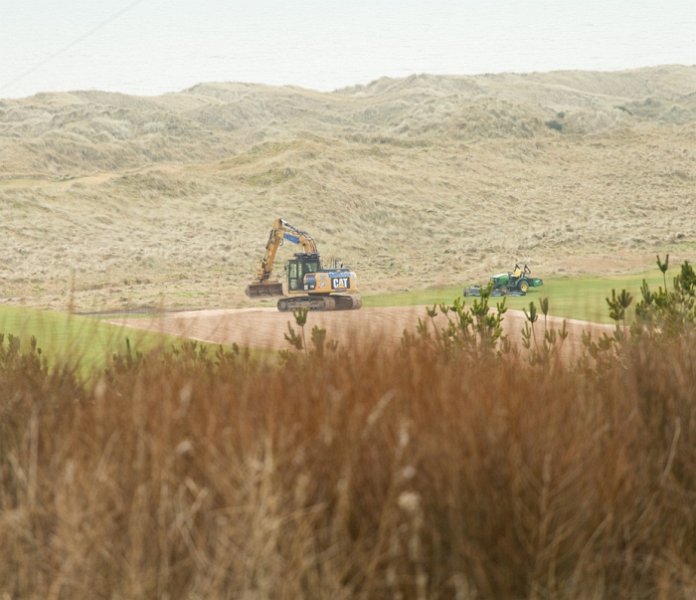
Another View Of Work Near Parking Lot 16 Feb 2013 Sqr Our elected officials largely shrugged their collective shoulders when consigning the Menie Coastline and its SSSI sites to history to accommodate Trump International Golf Links Scotland.
It was Aberdeenshire Council’s position that making money outstripped the importance of the Scottish coastal environment for present and future generations of people and wildlife.  They did phrase it a little less brashly than that:-

“Aberdeenshire Council supports the proposed development because the economic and social benefits through growing and diversifying the economy are sufficient to outweigh the conflict with national and development plan policies relating to the environment, protected landscapes and new house building.”
http://www.scotland.gov.uk/Resource/Doc/212607/0067709.pdf

At least a few gestures were made to protect whatever wildlife would survive comprising two 18-hole courses, clubhouse, parking, a 450-room hotel, 950 holiday apartments, 36 ‘golf villas’, 500 houses for sale, accommodation for 400 staff, and all the pollution this would bring.

An environmental advisory board, Menie (Links) Environmental Management Advisory Group, was appointed and Professor William Ritchie made its head.  Professor Ritchie has been Director of the Aberdeen Institute for Coastal Science and Management at Aberdeen University since 2002, and he has a long list of credentials.

Surely this would be a pro-active group headed by an experienced leader who would do everything possible to safeguard our environment and enforce any environmental conditions on the site.

Professor Ritchie is listed in the Menie Estate Report to the Scottish Ministers as being ‘in support of the case for the development For Trump International Golf Links Scotland’.  (http://www.scotland.gov.uk/Resource/Doc/212607/0067709.pdf)

Some would find this hard to credit – that an academic at Aberdeen University would prefer to see a golf course in place of two unique SSSIs which would inevitably be compromised.   (Later on in the same report, Ritchie seems to say he is neither for nor against the planning application, which seems contradictory to the contents pages).

Despite claims in the report that Ritchie was on the Trump side of the argument, no doubt he would actively protect what could be protected through his role at the newly-created body, MEMAG.

MEMAG:

MEMAG holds meetings – which, according to minutes, the Trump organisation rarely sends representatives to attend :-

“The group noted that the absence of TIGLS representation at recent MEMAG meetings wasunfortunate but, on a positive note, contact had been made with John Bambury (JB) who is the new LINKS Superintendent.”
http://www.memag.org.uk/Docs/Minutes%20MEMAG%20-%2031May2012%20Website.pdf

Do MEMAG members visit the site regularly?  Does MEMAG answer relevant questions in a timely fashion?  Does it exercise its authority relevant to the following provisions made in the Report? Among other powers:-

“MEMAG has authority to prevent damaging activities…”
http://www.scotland.gov.uk/Resource/Doc/212607/0067709.pdf

MEMAG’s own mission statement reads in part:-

“to monitor environmental changes;
“to advise on good practice managerial responses;
“to act as an independent check that developer commitments in relation to the dunes environment would be fulfilled;
“to advise on mitigation and minimisation of environmental impacts; and
“to commence work before site work begins and to continue to advise throughout the operational life of the development.”

But like the sand dunes, things had shifted by the time MEMAG’s inaugural press release came out.  MEMAG’s previous ‘authority to prevent damaging activities’ became:-

“For the avoidance of doubt, MEMAG operates as an advisory body only and will not have the power to veto any proposal or action proposed by TIGLS…”
http://www.memag.org.uk/Docs/MEMAG%20Press%20Relaease%201.4b%20Final.pdf

At the time of writing, MEMAG’s website had no minutes since June 2012, and has not responded to some dozen environmental questions it received from me on 23 January.  Residents I have spoken with are not aware of having much or any contact with, or sight of MEMAG personnel visiting the site.

The following observations from my visit of 16 February should ideally be looked at by MEMAG, but perhaps it is time MEMAG itself should be looked at.

Digging the Scene

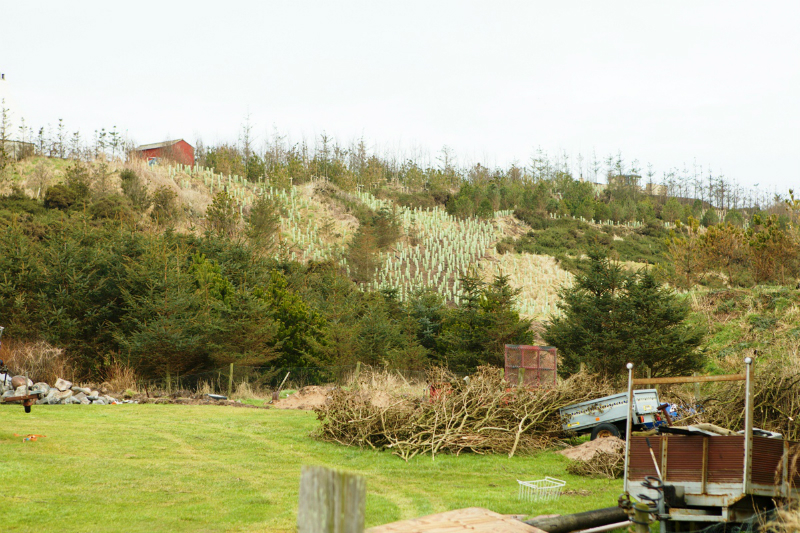
Attempt To Plant Forest Between Milne Home And Sea View 16 Feb 13 I walked the site for several hours on 16 February with an Aberdeen Voice photographer.  There seemed to me to be work in progress without specific planning approval.
Retrospective permission has been sought after work is completed on this site before, such as for the gigantic earth bunds which block light near the Munro property.

Surely the environmental monitors would step in and halt any further unauthorised work?

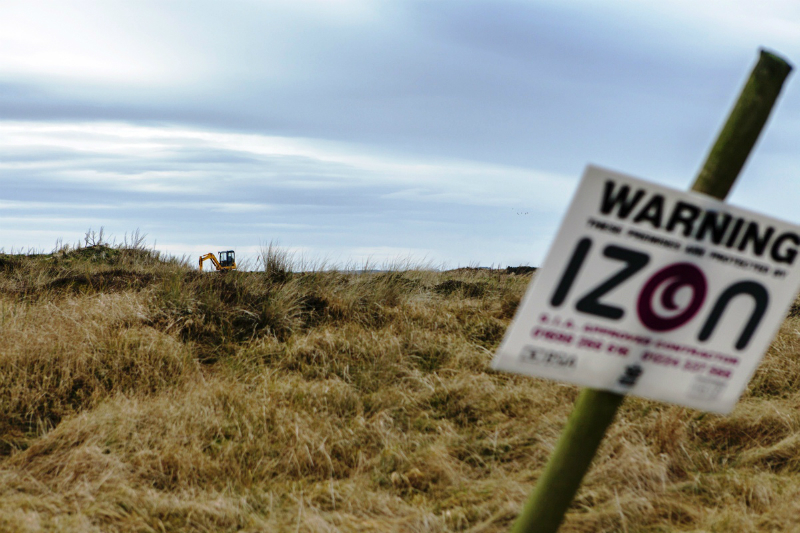
At 11am on 16 February I observed three separate sites where earth moving equipment was in operation for work which had not been approved as far as I or the residents knew.  Other vehicles on site included a digger parked near the Blairton Burn, which has permission for a bridge, as well as ever-circling IZON security vehicles visible several times on our walk.

The first work in progress is near the parking lot; a digger ( pictured top right ) is levelling out a large rectangular area.  I wonder whether it could be for the temporary marquee, which is not yet approved.

Another earth-moving vehicle was digging; I cannot tell what the purpose was.  This was on the west side of the course.  Finally at the very south of the course a third vehicle was also digging.  This might be the area set out for the second, as yet unapproved course.

This second course was announced with some fanfare in the press, but  no plans are available for it yet on the council website, and in a phone call, Aberdeenshire Council confirmed they do not have the plans.

These possibly unauthorised works were reported to Aberdeenshire Council’s Planning Department by email and phone from 17 February.  Although any unauthorised works can theoretically be stopped immediately, I have yet to receive word as to whether work has stopped, nor do I have any response yet from the council about this work.

The Blue, Blue Grass of Home

Like the pate of a certain bellicose billionaire, the greens of the first course seem to be thinning.  In the first case, a subtle, unnoticeable comb-over hairstyle is the answer.  In the case of the greens the answer is apparently – blue dye.

The Grass Is Greener On The Other Side Once Its Dyed. By SK16 Feb 2013 My visit on 16 February to the site was prompted by comments from a frequent Balmedie visitor:  huge swathes of the green (and a little patch of sand) had been ‘spray-painted’ a blue-green colour.

Mother Nature seems not to be accepting the imposition of this golf course on the coast very well.  First, part of the course was washed out to sea in winter storms.

Now the winds are blowing sand (hardly surprisingly) across the turfed areas, which can’t exactly be helping the grass to grow.

The height of the grass on some of the greens above the sand is very short indeed, making it seem that sand is covering the lower parts of the blades of grass. Is it possible that the grass is turning yellow in response to the sand and its proximity to the salt spray from the North Sea, making a dose of blue dye necessary for the appearance of health?

To me, from a distance the colour effect is of a less-than-natural turquoise green coloured grass.   On closer inspection it is, to my eyes, violently unnatural.  (Note – at no time did we walk on the greens, which would have been contrary to access codes).  My personal reaction is that had I been a millionaire golfing tourist, I would not be best pleased to have flown into Aberdeen to look at blue-green dye.

To digress for a moment from the lurid chemicals being used to dye the course – and the questions this raises about what other chemicals may be in use – at the area south of the Blairton Burn, the course is laid out in such a way that the only way to avoid walking on the greens for several yards is on a very narrow, steep sand dune bank.  The following excerpt from the Report springs to mind for several reasons:-

“2.1.54 Professor Ritchie thought that the fairway of hole 14 would be 30 - 40 metres away from the coastal dune and was surprised to be told that it scales at 21 metres on T2. …. It remains the applicant’s position that the coastal dunes should not be touched.” - IBID

At the point south of the Blairton Burn the green is only a few meters at best away from the coastal dune.  It is as if the movable sand dune system was – moving.  While the ‘applicant’ may have asserted that the coastal dunes ‘should not be touched’, arguably they are being planted with Marram grass and otherwise ‘touched’.  No doubt this will be of interest to the appointed environmental protectors as well as work at the Blairton Burn area.

Blairton Bridge Burn

The area which eroded into the sea is now being fortified with stone/concrete blocks at the sides of the burn.  Rocks are used at the base of some nearby dunes stretching towards the sea.  Whether or not this rock installation is on Crown land and meets with Crown approval has yet to be determined.

Perhaps it is time MEMAG visits the course again and considers whether some of it is far too close to the shore, making the course potentially likely to erode into the sea, and making life for people who wish to legally walk around the course difficult if not potentially dangerous.

How Green are Golf Course Greens?  The Green Desert

Sheen On A Rust Coloured Pool Also Seen In January On Side Of Course 16 feb 2013 Is a golf course, set in an idyllic countryside setting necessarily a green haven?  Not necessarily.

I am unable to confirm reports that burrowing animals were gassed in order to create the course and maintain its smooth contours, but this is the suspicion of some of my sources, and would not be without precedent in the industry.  The long list of environmental charities objecting to the development included the SNH and RSPB.

A pool of water visible on the side of the course at both my visits is a rusty brown colour with a sheen on it.  This is not a large pool, but if I wonder about what is making it discoloured and oily, perhaps MEMAG should be likewise curious.

Aside from coloured dye, what other chemicals are being used?  Are golf courses perfectly safe?  There is growing evidence that fertilisers, pesticides and other chemicals may have some serious consequences for wildlife and people.

In their article entitled A Global Perspective on the Environmental Impact of Golf, Kit Wheeler & John Nauright collate some worrying statistics on human health and environmental damage resulting from the creation and maintenance of golf courses. The aims of the article include:-

“… examination of the environmental impacts that accompany projects that fail to take the environment at large into account; to discuss some of the implications for developing countries being targeted by money-hungry developers…”

I recommend reading the paper in full, but here are some excerpts:-

“One of the more obvious, and potentially dangerous, ways a golf course can impact the environment is through the large-scale application of chemicals including fertilizers, insecticides, pesticides and fungicides. These chemicals can be damaging, sometimes even lethal, to organisms that are exposed to them, either in the water, on the ground or even in the air… ”

“Chatterjee’s study published in 1993 stated that an average of 1500 kg of agrochemicals, some of them known carcinogens, are applied to golf courses each year and that 90 per cent of sprayed chemicals end up in the air.[30] A subsequent study by Chamberlain iterated that a typical 18-hole course uses 22,680 kg of dry and liquid chemicals annually.”

and

“It has also been shown that people who spend a good deal of time around [golf courses]… may also be susceptible to the effects of hazardous chemicals. …USGA volatilization studies report that organophosphate insecticides that possess high toxicity and volatility could result in exposure situations that cannot be deemed completely safe as judged by the US Environmental Protection Agency (EPA)…”
- A Global Perspective on the Environmental Impact of Golf, Kit Wheeler & John Nauright
http://reearth.org/wp-content/images/2008/03/golf_environment.pdf

What Is This Earth Moving Vehicle Doing? 16 Feb 2013. Golf And A Good Walk Spoiled

Part of the importance of the environment is our legal right to enjoy it.
The post of countryside access officer for the Menie area remains unfilled for some months; this person would be responsible for ensuring people can enjoy the area without security intervention or locked gates (at least two sites have gates which are locked making paths inaccessible to bicycles or people with mobility issues).

Finally

Failing any dramatic development, this will be the final article in this series, and a final report with recommendations will be issued soon.  Considering the way we have made people, the environment, and our own laws bend to the will of one man on a quest for a golf course, it is hard to see what we will ever gain, or whether next generations of people will thank us (or if there will be next generations of wildlife on that stretch of Scottish Coast).

Wheeler & Nauright summed the situation up perfectly:-

“Local communities are routinely excluded from the decision-making processes regarding course development… After losing their battle against developers, local residents often lose their land next. … These types of changes can wreak havoc on rural communities while also exacerbating urban problems of slums, pollution and congestion.”

Perhaps when we are all wealthy as a result of this ‘£1 billion pound’ development we will be wealthy enough to jet off to some unspoilt natural coastal resorts for some fresh air. 

Then again, we could simply have realised what we had before Trump came to town.

  • Comments enabled – see comments box below. Note, all comments will be moderated.

Jan 242013
 

Following a comment made on a Facebook debate about the difficulty local construction companies can experience in winning building contracts, Voice invited Kenny Anderson to explain further the issues which can leave small local companies at a disadvantage. 

kenny-anderson_pic2 First of all, I’m not having a go at the current local administration or the last one either – I believe problems are caused by the zealous behaviour of officials and civil servants.

For example, in straightforward financial terms we came second for a contract a couple of weeks ago.
We have no problem with that, since all six tenderers were perfectly capable of doing the job.

Some you win, some you lose.  The problem is with the weighting applied to the decision-making.

The lowest tender in this instance was submitted at £315,000.  Ours came in at £321,000, but the clear-cut arithmetic price only carried a 40% weighting, whilst the entirely subjective Total Quality Assessment (TQA) element carried a 60% weighting.

The end result was that a tender for £399,000 was accepted, thus costing the customer and tax payers an additional £84,000!

This is repeated in award after award in some areas of the public sector.  Under TQA guidelines, each tender applicant has to submit a Lever Arch file’s worth of job specific programmes, method statements, personnel CVs and other project-specific information with each tender, meaning that the system is loaded in favour of large companies with planning departments.

Small and medium enterprises (SMEs) like ourselves can’t justify having senior managers spend four or five hours doing this for each of the ten to fifteen jobs we bid for every week.

It’s not that we object to providing such level of detail as a condition of acceptance, prior to acceptance and site start.  If we failed to do so, we’d expect the contract to be awarded to the next contractor.

Meanwhile, we subscribe to Constructionline, a self-financed scheme run by the UK government for all government agencies, including local authorities and housing associations.  It checks our finances, insurance arrangements, capabilities and so on, providing this information free of charge to government agencies.

Some agencies, however, still choose to sift through this vast array of information for each tenderer themselves, which is incredibly wasteful.

The old system worked on the basis that if you were suitably qualified to do the work, the lowest tender was appointed, and if you screwed up, you were removed from the approved list until you could prove that you’d addressed concerns, whereupon you’d be given a second chance.

it’s common for SMEs to be screwed, by not being paid, by being paid late or by having deductions made

New companies built up gradually from undertaking smaller jobs and out of town contractors who had a track record and wanted to trade here got their chance too.  It was simple, transparent and fair.  Brutal at times, believe me, but fair!

Now frameworks, hub agreements and suchlike exist nationwide and clearly discriminate against SMEs.

The government argues that SMEs can sub-contract work to big contractors.  How likely do you think that is?  And when this happens it’s common for SMEs to be screwed, by not being paid, by being paid late or by having deductions made.  You’re effectively playing poker with billionaires, so the legal system is too slow for worthwhile recourse.

Value for money?  I don’t think so, and there are numerous tricks the big companies could potentially employ to rip off the public sector.

All the while, it is SMEs who maintain local offices paying full business rates, take on staff on traditional contracts and recruit apprentices and young administrative staff trainees.

One large nationwide company operating in Aberdeen ‘uses’ sub-contractors, has most of its managers on fixed-term contracts and doesn’t take on apprentices.  Several huge, high profile local contracts are being undertaken by similar contractors who operate this way.  One locally-based big company used to take on 40 apprentices every year but they’ve been undercut by large management contractors and cannot now recruit the volume of apprentices they once did.  This is a travesty.

I have to stress that I’m not against outside contractors coming in, I just think they should have to establish a base, employ people appropriately and recruit trainees and apprentices as we do.

If every construction company in the UK had the same proportion of trainees and apprentices in its workforce as us, youth unemployment figures would be dramatically lower!

I’m giving evidence to the Scottish Government Procurement Inquiry although I’m very concerned my comments will fall on deaf ears.  I hope I’m wrong, but I suspect I’m right.

Kenny is MD of Anderson Construction, based in Northfield, Aberdeen and is former Chairman and elected Trustee of the Chartered Institute of Building (CIOB) Scotland.

  •  Comments enabled – see comments box below. Note, all comments will be moderated.
Oct 222012
 

Row Of Bricks 122 By Bob Smith. 

Mair hooses are tae bi biggit
Near Pinewood, an Brig o’ Don
Is’t nae time tae ca a halt
An say noo jist haud on?

Faar there’s biggins ye hiv cars
At least een tae iverry hoose
Jist think o aa the clutter
If mair motorists are lit loose

Noo fowk div need a hoosie
Faar tae bide there’s nae doot
Yet a bittie sinse is needed
Afore the foons they are laid oot

Dinna bigg in the suburbs
Some planners noo div cry
Cos congestion on the roadies
Ye wull git by an by

Developer chiels they scoff at iss
Sayin new hooses they maan bigg
Tae maximise aa their profits
Be it Grandholm or near Nigg

Aboot aa iss hoose biggin
Fowks we maan hae a think
Afore iss gweed lan o oors
Ooner  hooses it dis sink

So awa an bigg yer hooses
On an inner city broonfield site
Afore aa oor bonnie green parks
Are a mass o concrete shite

©Bob Smith “The Poetry Mannie” 2012

Picture  © Madartists | Dreamstime.com
http://www.dreamstime.com/row-of-stones-patio-bricks-imagefree19977

Mar 192012
 

A proposal to build a road through woodland in Ellon has come under fire from a group set up to support the management of the area. The intended purpose of  road is to provide access for the development of 250 new homes. Those opposed to the plan believe the road is unnecessary, destructive, and in contravention of a Blench Charter. Friends of McDonald Park founder member Lynn Gilbert brings Voice readers the story.

cwwpic1 The plan is being opposed by Friends of McDonald Park, a group set up by Aberdeenshire Council in 1990 when the Council bought the superiority of the Park from the charity Barnardos.
The aim of the group is to support the management of McDonald Park for the benefit of the community. We have done this by planting bulbs, trees and a hedge as well as regularly clearing litter from the ground and from the Modley Burn.

The Park was given to the Burgh of Ellon in 1928 by Sir James McDonald and is governed by a Blench Charter.

The terms of the Charter state that the Park should be used for recreational purposes only, that nothing should be done which is detrimental to the Park and that its area is not to be reduced in any way.

In 1996, we successfully opposed a plan by Aberdeenshire Council to use part of Caroline’s Well Wood, the east section of McDonald Park, as a bus park for Ellon Academy. On that occasion we raised the terms of the Blench Charter and an alternative solution was found without destroying any of the Park.

In 2010, builders Barratt East Scotland and Scotia Homes were given Council permission to construct 250 houses in Ellon’s Castle Meadows but it was only when marks appeared on trees in the east section of the Park, that it became apparent that the plan was to construct a road through it, from the development site to Golf Road. I made enquiries on behalf of the Friends and was told that the road had been approved by councillors.

In August 2011, the Friends were informed in a Council Estates Department letter that an S75 Legal Agreement for the application had still to be signed, and were asked for their views on the proposed access. The same letter stated that legal advice given to the Council was that:

“vehicular access must facilitate/improve public access to the park and cannot be granted purely to allow development”.

The Friends voiced total opposition to a road through the Park, stating that it would be in contravention of the Blench Charter since it would not improve public access to the Park, but was solely for the development. It would also involve the felling of a large number of mature trees in an area inhabited by red squirrels, bats and spring/early summer migrating birds.

It would seem that councillors were not satisfied with the legal opinion offered and they sought further advice several times from Sir Steven Stuart QC. This was given in a privately-heard report presented at a Formartine Area Committee (FAC) meeting on 6 December last year. It suggested that temporary construction access could possibly be granted, subject to a number of safeguards and agreements being in place.

  The Friends and many others have lodged objections to the planning application

On 17 January, a report to the FAC, again heard in private, proposed a temporary five year construction access which would become a pedestrian and cycle path once the five years had elapsed. This temporary access would be a tarred road with lighting and other services and which would involve the felling of at least 99 mature trees.

It would take a fifteen metre slice of the woodland at the Golf Road end, this increasing to nearer thirty metres at the top, a significant area of the Park.

It seems that when councillors first approved this access, they were not aware that they themselves were in fact Trustees of McDonald Park. It was in this capacity that councillors had to consider the application at their 28 February meeting, and as Trustees they rejected it.

This application is to be considered at a Planning meeting on Tues 20 March.

The Friends and many others have lodged objections to the planning application, and I have asked to speak at the meeting should it be heard there. Quite apart from the effect of this road on the woodland, a precious asset to Ellon, there is another matter to be considered.

Construction traffic using Golf Road would access the Park at the rear of Ellon Academy, an area used by a large number of Academy pupils and mothers with buggies walking into Ellon. There are two other access roads to the development, but some residents along these routes would rather see part of McDonald Park destroyed than have traffic pass their homes.

Interestingly, the site of this proposed access is given as ‘Castle Meadows’ on the planning application, when in fact it is McDonald Park. This makes it easy to overlook the reality of the situation.

Further info: Save McDonald’s Park Caroline’s Well Wood Ellon : Facebook Page
Image credit: Ian Jukes 

Feb 242012
 

Peter Veritas makes the case for voting “Retain”.

1.  There is a very real danger that the City Garden Project will bankrupt Aberdeen.

item-1 The City Garden Project (CGP) is planned for a greenfield site which would require substantial excavation. It is a five acre, five storey, underground construction that would span both a main road and a railway track

It’s roof would be required to hold approximately ninety thousand tons of topsoil, the same weight as the worlds largest aircraft carrier.  It is projected to cost £140M.

Union Square, which is of a similar size, was built on a flat brownfield site with good access. The final cost was £250m.

Marischal College is a much smaller existing building that was recently renovated.  No major construction was performed.  The final cost came to £65M.

Given that context, how can we be expected the believe the estimate for The City Garden Project is realistic? Should the City Garden Project experience a similar scale of overspend to the Scottish Parliament Building or the Edinburgh trams, then the shortfall could conceivably be of the order of £360M.  The city, which is already £560M in debt, would be liable for this overspend.

It could not be rolled up into the existing loan, and would require immediate payment.  Failure to cover the overspend would result in us being left with a dirty hole in our city centre.  The only options open to the council would be to auction off it’s remaining assets, such as the other parks, to property developers, and to increase council tax  massively.  Public services which have already suffered severe cuts would be totally decimated.

2.  Aberdeen has suffered badly from previous developments.

item-2 St Nicholas House, the New Market, The Denburn dual carriageway, the Denburn Health Centre, The St Nicholas Centre, and Virginia Street are all universally acknowledged as failures that now blight our urban landscape.  Aberdeen lost many beautiful buildings to clear the way for those developments.

The people who campaigned against those architectural and planning atrocities are also campaigning against The City Garden Project.  They’ve been proven right time and time again. Perhaps it’s time we listened to them?

3.  We already voted against this Project under a different name.

item-3 There is something sinister about the City Garden Project.  It was originally conceived as the City Square Project (CSP), and envisioned as a five acre flat concrete piazza.  That proposal only emerged after Peacock Visual Arts were given planning permission to embed an unobtrusive arts centre into the hillside of Union Terrace Gardens.  Sir Ian Wood pledged £50M to build The City Square, but promised to scrap the Project if the public rejected it.

That was then put out to a flawed public consultation, in which the public voted against by a substantial majority, despite the online survey mysteriously defaulting to a “yes” vote.  Sir Ian then reneged on his promise and continued to push the concept, the council ran roughshod over the electorate, and by the casting vote of the Lord Provost, consigned the Peacock plan to the dustbin.

Sir Ian has consistently stated that he will only contribute his £50M to this particular proposal and nothing else, and that if we reject his proposal then he will divert the money to Africa.  His behaviour is baffling.

4.  There has been an air of deception around The City Garden Project.

item-4 The City Square Project was rebranded as The City Garden Project.  During the Project’s second coming the public were presented with six designs and invited to vote on them. None Of The Above was not a option.

Aesthetically, the public appeared to favour the Winter Garden design.  From a conceptual perspective The Monolith design was arguably the most cohesive.
The appointed panel then refused to release the outcome of this public vote and instead selected The Granite Web, a design for which very few people acknowledge having voted, and which many people considered to have been among the weakest.

CGP propaganda has continually claimed that Union Terrace Gardens are a dangerous place, but Grampian Police crime figures reveal that they are actually among the safest places in the city centre. Neighbouring Belmont Street, which the plans propose to connect to the Granite Web, is statistically the worst area for street crime.

Under the rules of the referendum, registered campaign groups are limited to £8k spending to maintain a level playing field.  However a mysterious group of anonymous business people has allegedly ploughed £50K into sending pro-CGP propaganda to every home in Aberdeen City.  This is not within the spirit of the referendum and is arguably a breach of the rules.

It has been claimed numerous times that the 250 year old elm trees in Union Terrace Gardens are diseased, but a recent report by a tree surgeon has given them a completely clean bill of heath.  These elms are among the last surviving in Europe, and they flourish both due to their isolation from other elms, and because the pollution of the city prevents Dutch Elm disease from spreading to them.  These trees are all covered by a preservation order.

5.  Those arguing in favour of the City Garden Project are mostly connected to it in some way.

item-5_0 Scotland’s top public relations firm were engaged to promote the Project, which may be why the majority of stories that have appeared in the local press have been fawningly in favour of the CGP.

Those who have argued the merits of the Project, both in the press and on-line, are interconnected people with an as-yet unknown agenda.

In addition to the numerous PR professionals being paid thousands of pounds each day to present the case, there are several property developers, the owners of assorted the premises on Union Street, and various oil company executives.

No fewer than three city councillors, who backed the Project, recently announced that they intend to stand down, and have also revealed that they are planning to leave the city.  Virtually all of those involved are members of Acsef, Scottish Enterprise, the Institute of Directors, and The Chamber of Commerce.  The same dozen people feature time and time again in the groups which have come out publicly in favour of the Project.  The same people wearing different hats.

6.  The economics have no basis in fact.

item-6 Tax Incremental Funding (TIF) is intended to fund the redevelopment of brownfield sites.  Businesses which later setup in and around those sites pay increased business rates which repay the cost of the development in a similar manner to a mortgage.  The business case for this Project bends the rules since the increased rates will not be gathered for the site itself, but from two new industrial estates, located several miles away and for which planning permission has already been granted.

The 6,500 jobs and £122M of projected annual revenue are a product of these new industrial estates working at full capacity. This is almost  guaranteed to occur anyway without The Granite Web.

Furthermore, the paid author of the reports is PricewaterhouseCoopers (PWC), which has recently been fined £1.4m for audit failure.  PWC rates the TIF case at Risk Level 3, where 4 is the highest risk.

7.  To save the architecture of the Denburn Valley

item-7 None of the Granite Web mockups, artists impressions, or video, have addressed the issue of the rear elevation of Belmont Street.

This is home to some of Aberdeen’s most spectacular architecture, descending right down to the level of Denburn Road.  Architecture which will be obliterated when the CGP connects to it, some five storeys further up.

Most of these buildings are either local businesses or publicly owned concerns, and several of them have picturesque balconies below the finished level of The Granite Web.

8.  To retain our sheltered park.

item-8 Union Terrace Gardens lie in the Denburn Valley which offers shelter from the wind and urban pollution.  Raising the area up to street level would turn it into a wind trap.

The wind would howl round the concrete walkways and other architectural features of the granite web, plants would struggle to survive, and people would avoid the area, preferring instead to travel along the relatively sheltered confines of nearby streets. It’s a fallacy to claim that this development would enhance connectivity.

9.  Union Terrace Gardens have been cynically starved of funding – in order to ‘pave the way’ for this redevelopment.

item-9 Union Terrace Gardens was the centre piece of Aberdeen’s famous successes in the Britain in Bloom contest.  Over the course of the past eight years the council has cut funding, with the result that the Gardens are no longer maintained at previous award-winning levels

The beautiful Grade A listed public toilets were closed, the famous giant draught boards were ripped out, the winter skating rink was no longer installed and concerts and other public events were discontinued

A modest investment would both regenerate the Gardens, and improve access to them.  There is no need to risk bankrupting the city for what amounts to no additional benefit

10.  The curse of Corbie Haugh.

item-10 Back in the seventeenth century, the area where the Gardens now stand was a wood called Corbie Haugh. The ancient Scots word for crow is corbie and the wood was named after the crows which gathered in the grassy valley and within the bank of elm trees. The elm trees in the Gardens date back over 250 years to that eighteenth century wood.

An ancient legend, The Curse of Corbie Haugh, holds that when the crows depart, the city will be ruined. If the elms are chopped down, the crows will indeed depart, and if they city ends up burdened by an additional £360m of debt, then it shall indeed be ruined!

SAVE OUR CITY FROM DISASTER BY VOTING TO RETAIN UNION TERRACE GARDENS.

  item-12 item-13

Feb 232012
 

Next Friday (March 2nd) we will know the fate of Union Terrace Gardens. The results of the public referendum will be announced then. Will there be wild celebrations in the park itself or will the champagne corks be popping in the boardrooms? writes Mike Shepherd.

The Importance of Union Terrace Gardens 

greenhrtpic I agree with the comment that in your mental map of Aberdeen, Union Terrace Gardens is at the centre of it. This observation gets right to the core of the controversy.
I’ve heard Sir Ian Wood dismiss the idea of building a civic square on the St Nicholas site. As far as he is concerned the Denburn is the heart of Aberdeen, and that’s where the civic square / garden should go.

The fate of our park will be highly symbolic for the future of Aberdeen city centre. If you agree to retain the Gardens, it’s a statement that heritage matters in the city centre and there is a will to maintain the historical nature of down-town Aberdeen.

On the other hand by agreeing to build a modern park and structure, this would probably give the green light to extensive development of the city centre. As the TIF business report for the City Garden Project states, the scheme could stimulate the establishment of a central business district and the accelerated construction of city centre office blocks.

The alternative is so much more attractive. With Jimmy Milne’s business fund we could sympathetically restore Union Terrace Gardens at a fraction of the cost. It would be a marker for preserving our city centre heritage.

The Erosion of the Character of the Granite City

My background is geology and I grew up near Rubislaw Quarry.  The geology of Scotland varies so much, it means that each town and city has its own distinctive building stone. This creates a strong sense of place and belonging unique to each part of Scotland.

I was born in Aberdeen and I love the granite buildings with a passion. It breaks my heart when one is pulled down and a concrete and glass box of no redeeming character is put in its place. I would agree with the sentiment expressed in the old Aberdeen City Plan (very tellingly omitted from the new plan that has just been approved):

“The standard of design in new development has been raised as a widespread cause for concern during the preparation of this Local Plan. This is one reason why new development can raise so much hostility amongst the public and this situation must change. The City has such a rich and relatively intact heritage of older buildings that shortcomings of newer ones are all the more obvious. It is necessary to encourage better design.”

The loss of Union Terrace Gardens could be the start of Aberdeen losing its special character as the Granite City. More and more old buildings may be lost, until the city starts to look like everywhere else. This would sadden me immensely.

A Test for Local Democracy

I also see the Union Terrace Gardens as a test case for local democracy. Despite the public referendum, local democracy has failed miserably on the issue. The development of Union Terrace Gardens was imposed on the public from the start with no serious attempt to build consensus. A so-called public consultation was run essentially as a marketing exercise, and when it failed to convince the Aberdeen public, it was conveniently ignored.

foutgagmpic The recently held ‘public consultation’ on the design is remarkable in that the results were not even made public. Even the referendum has been lop-sided, with a massive public relations exercise on one side combined with a local press willing to publish anything it gets. There have been some new lows in recent days (see Richard Pelling’s article on the subject).

Will the public assert themselves against the machine? I hope and trust they will. If not, expect much more of the same.

A Waste of Public Money

Recently I received an email from the managing director of an oil service company in Aberdeen. He described the idea of using Central Government funds for the City Garden Project as a terrible waste of investment and infrastructure money. His opinion is that the city centre development will not affect the decision by oil companies and personnel to move to Aberdeen or otherwise.

“Companies invest in Aberdeen because of the fantastic talent pool, the high standard of living, the stable fiscal regime (assuming Osborne doesn’t have any more surprises), the access to West Africa and other merging oil & gas regions which are increasingly supported from Aberdeen.”

I agree. What is calamitous is that if Aberdeen Council was going to apply for TIF funding, they could have found much better projects than Sir Ian Wood’s city garden. How about these:

a. Revamping the Beach area

b. De-bottlenecking Aberdeen’s congested roads

c. Building the AREG renewable energy centre

 - And just about any other project you could think of.

If the City Garden Project goes ahead, we will have replaced a park with a park. Is this what we should be doing with public investment money in Aberdeen? Most certainly not.

If you agree with any of this and you haven’t voted yet; vote Retain Union Terrace Gardens (the option that does not destroy our Granite City).

Feb 222012
 

Almost every time Karin Flavill looks at the design for the Granite Web, the same question comes to mind. “What would Howard Roark think?” Intrigued? Read on.

utgbelmontpic

Howard Roark is the hero of The Fountainhead, a novel by Ayn Rand.

Rand is a controversial writer; aspects of her objectivist philosophy were transported across the Atlantic decades ago and transformed into what we call Thatcherism, so it’s safe to say that she draws strong opinion, from those who have heard of her, both here and in the US.

The attraction of The Fountainhead for me was that it gave me a glimpse into the unknown, that a philosophy designed to help the wealthiest members of society feel not simply financially superior to those who struggle, helps them feel morally superior to them too.

What is it that tyrants see that allows them to derive a sense of well-being when they look in the mirror? Reading Rand can help you find out, even if it’s unlikely that in reality, many of society’s bullies and elitists have the personal qualities and ethics Rand depicts in her heroes.

Roark may be a more interesting and relevant reference point than some other fictional characters who have entered the Granite Web versus Union Terrace Gardens debate. Jake the Ghost and Morris the Monkey for example, as promoted by the BIG Partnership, seem to have a peculiar and hopefully incorrect impression of what moves Aberdonians to vote.

Roark is his own man, and is Rand’s idea of the Perfect Man. A gifted and original architect, loathed by the majority for his innovation and commitment to the future, he despises architecture which draws irrelevantly from the past. His designs are modernistic and often hard for people to understand. The few who do understand become his friends, and are held up to the reader as exemplary beings.

In some ways, Howard Roark would seem to be another ideal spokesperson for the City Garden Project. On the other hand, this objectivist hero’s deepest contempt would be reserved not for those who disliked his designs, but for that partnership between business and government which is so conducive in the long run to crony capitalism. Hello, ACSEF.

  The pro-Union Terrace Gardens lobby regards the existing Gardens as a unique prize which could be something magical

Leaving the politics aside for a moment, would Roark look at the design and love it? I don’t know. I’m not an expert on architecture, but I do know a little more about people, and about conflict, and about the factors causing people beginning to feel alienated in their own city. Such doubts seem to be at the heart of this debate.

The pro-Granite Web lobby feels that Aberdeen requires a drastic makeover for it to become a place they would want to continue living in and that others would want to move to. The pro-Union Terrace Gardens lobby regards the existing Gardens as a unique prize which could be something magical if only people who understood it were listened to. The original Peacock Visual Arts design symbolises what could have been.

Throughout The Fountainhead, examples and analyses of the character’s genius as an architect are provided. One passage is, for me, particularly telling. Self-made man Mr Mundy has heard that Roark is a great architect, and would like Roark to design a house for him. Roark meets with him to ascertain what kind of man he is and subsequently what kind of house he would be happiest in.

“There was a place,” said Mr Mundy, “Down there near my home town. The mansion of the whole county. The Randolph place. An old plantation house, as they don’t build them any more. I used to deliver things there sometimes, at the back door.”

He goes on to describe the ways in which he would like to recreate that dream house, the house of his aspirations. From what we already know of Roark, he would dislike the notion of recreating something from the past. However, that’s not at the root of his disapproval of Mr Mundy’s aspirations. This is:

“It’s a monument you want to build, but not to yourself. Not to your life or your own achievement. To other people. To their supremacy over you. You’re not challenging that supremacy, you’re immortalizing it….Will you be happy if you seal yourself forever in that borrowed shape?…You don’t want the Randolph place. You want what it stood for.”

In other words, it’s not simply technical skill, the vision of the artist and the ability to give the client what he wants that makes Roark a great architect. He sees who people are, not as they want to be seen, or as they try to be seen, but as they are. It’s this ability to look past the hype, the pretence, self-advertising and PR that enables Roark to build houses in which people can feel truly at home.

Think of your own dream house. Would it be one that somebody else had designed? A talented design team who would create something that was a compromise between their personal tastes and your picture of who you would like to be? Who furnished it in accordance with those same principles? Would it be your home, or would it be a design piece reflecting aspirations of who you wish you were, rather than who you really are?

  Who are we, in Aberdeen? A conflict like this forces us to consider that question in some depth

The promotional video for the Granite Web presents a futuristic world peopled with white, transparent figures ambling aimlessly through flower beds, staring uncomprehendingly at car parts dangling from a roof, drinking coffee. Observe, consume, observe and consume.

These transparent figures aren’t creators or innovators. They simply absorb, passively, that which has been transported from elsewhere to make the city seem more impressive to outsiders. A place that might, at some future date, be awarded City of Culture status!

The promotional literature keeps insisting that this will be the people’s park. It encourages readers to imagine themselves consuming all that the park has to offer, in the belief that this will result in them achieving a sense of ownership over it. There will, we’re promised, be spontaneous performances, but it’s not clear who will provide these. Perhaps musicians drafted in from outside.

Who are we, in Aberdeen? A conflict like this forces us to consider that question in some depth. My impression, living here, has always been that Aberdonians tend towards reserve, despite night-time scenes on Union Street when alcohol loosens inhibitions. The notion that we can buy a totally different character for Aberdeen, via an expensive raised park, seems dubious at best.

Union Terrace Gardens exemplifies the typically reserved nature of the Aberdonian. Like a Christmas tree that contains only a few, semi-concealed fairy lights, it is capable of emitting the magical quality that a garishly decorated tree cannot. The magic of mystery and discovery, and something very different from the usual variation on the iconic city centre park that is springing up all over the world.

One person’s iconic, radical, inspirational park is another person’s pretentious vision of future dystopia. I’ll admit I belong to the latter category, which is why I’ve already voted to retain, and improve, Union Terrace Gardens. Peacock Visual Arts was a local initiative which would have provided a place where people interested not just in consuming the arts but in contributing actively to them could have congregated. That was an exciting notion.

The Granite Web, on the other hand, constitutes yet another ‘space’ in which the people who live here may perform a passive consumer role.
Sir Ian Wood believes that he is giving Aberdeen a gift, and has expressed hurt that many in the city fail to appreciate this. The difficulty is that altruism doesn’t always create a sense of self respect in the recipient.

The price paid for that altruism is that the opportunity to create and innovate is taken away from people in the community, limiting their opportunity to participate to that of being passive consumers. For some, regardless of the risk of being branded ingrates, that may be too high a price for them to enter voluntarily into this particular contract.

Feb 102012
 

The uncertain fate of the ancient elms in Union Terrace Gardens is highlighted by Mike Shepherd.

utgsaw There are 77 mature trees in Union Terrace Gardens and a few more along the adjacent railway line. It is not clear how many of these will be felled during the construction of the proposed City Garden; however most will probably go. An Evening Express article suggested that they will all be removed, whilst it was mentioned at the January council meeting that some of the trees in the north-west corner may be kept.

Rather bizarrely, the same Evening Express article mentions that the wood from the Union Terrace Gardens trees could be recycled for the construction of the City Garden, that is for paths and the wooden roof of the outdoor stage, “keeping them in the garden”.

It is proposed that the new trees in the City Garden will comprise a “mini-forest” of 186 trees, mostly Scots Pines.

The fate of the twelve elms in the park is a highly controversial issue. A handful of these trees are considered by the council to be at least 200 years old. They may be even older. A report gives mention to the planting by the Town Council in 1764 of a thick woodland on the hillside to the west of the Denburn.

The trees in the park are disease-free. Occasional comments made by certain ill-informed councillors that Dutch Elm Disease is present in the Gardens are not true. The trees are inspected from time to time. The symptoms of the disease show up in the summer when leaves turn yellow and fall off early. This has not been seen in any of the Union Terrace Gardens elms.

 As far as mature trees in the city are concerned, the council can do what it wants.

The disease, a fungus carried by bark beetles, has devastated elm trees throughout most of the UK. It is estimated that more than 25 million elms have been killed by the disease with very few mature trees left.

The disease spread to the north of Scotland only in the last twenty years and pockets of relatively disease-free elms have survived here. Aberdeen city is one such pocket. The disease has been recorded in only a few trees in the west end of the city, but it is generally absent.

Elsewhere in the north-east, Dutch Elm Disease has recently been killing large swathes of elms. Most, if not all, of the elm trees on Drum Castle Estate have succumbed, for example. It is to be hoped that the city stays relatively clear of the disease for as long as possible.

Aberdeen is said to have “possibly the largest remaining population of elms in Northern Europe that has not yet succumbed to the deadly Dutch Elm Disease.”
http://frontpage.woodland-trust.org.uk/ancient-tree-forum/atfgallery/galleryphotographers/geoffbanks/images/geoffproject.pdf

The mature trees in Union Terrace Gardens have been assigned Tree Preservation Orders by the Council. A document is available online which explains the policy towards protected trees in Aberdeen. The following are quotes from the document:

“A tree preservation order (TPO) is an order made by us, giving legal protection to trees or woodland. A TPO prevents cutting down, uprooting, topping, lopping, wilful damage or destruction of trees (including cutting roots) without the council’s permission.

“The purpose of a TPO is to protect trees that contribute to amenity and the character and attractiveness of a locality. Other factors such as heritage and wildlife value can be taken into account. A TPO gives the council an opportunity to assess the impact of work to trees or proposals which may affect them.” However, it goes on:

“The existence of a TPO can not in itself prevent the development of land taking place, but the council, as planning authority, has a duty to have regard to the preservation and planting of trees and the likely effect of development proposals on trees is a material consideration.”
http://www.aberdeencity.gov.uk/nmsruntime/saveasdialog.asp?lID=25378&sID=13464 

utgedward In other words, as far as mature trees in the city are concerned, the council can do what it wants. A tree preservation order on the Union Terrace Gardens elms does not necessarily protect them.

The result of the referendum on the Gardens in March will also decide the fate of the elms. For some in the city, it is a major issue. They see the removal of the trees in Union Terrace Gardens as a crime against nature. These are amongst the last surviving mature elms in the country, Europe even.

For many it would be a sad day if and when they are chopped down. There is an online petition to save the 200-year old elms:
http://www.petitiononline.co.uk/signatures/save-the-200-year-old-elms-in-union-terrace-gardens-aberdeen/4168

Dec 152011
 

Voice’s Suzanne Kelly provides further detail regarding The Scottish Information Commission’s decision on Aberdeen City Council’s handling of FOI requests regarding  sales to and contracts won by Stewart Milne related companies.

  Town House From Castlegate This week the Supreme Court sided with Aberdeen City Council and rejected Stewart Milne’s appeal concerning profit-sharing on a land deal.

Milne bought land from Aberdeen City Council (property worth some £5 million was sold to him for c £375,000) with a clause stipulating Milne had to share any related profits with the seller, Aberdeen City Council.

After lengthy appeals, the Milne Group must pay £1.7 million pounds to Aberdeen City Council (legal costs are at present unknown).

Precisely how and why the cash-strapped City Council made this deal still remains unclear.  Once acquired, the property was sold from one arm of the Milne group of companies to another, and on this basis, Milne’s position was that there were no profits to share.  The Courts have disagreed.

This issue spurred a freedom of information request to the City Council.

What land had been sold to Milne-related companies?  What contracts had been awarded to the Milne companies?   Was a group of companies receiving preferential treatment by being sold public assets without the assets going on the open market to the highest bidder?  Was a construction firm buying land at considerable discount with one hand, and at the same time under-bidding competition to win work?

It is a year (and a few days) since the initial FOI request was lodged with Aberdeen City Council.  Late replies, denials that information was held, assertions that information was too difficult and costly to obtain were some of the obstacles in the way of obtaining information.

If not for the Information Commission, there would be no chance of this information – concerning public assets and the public purse – coming to light.  As it is, the City has until 23 January to finally comply.  At that time it must either disclose the information or lodge an appeal against the decision.

The decision will be disclosed to the public  around 16th December.  In the meantime, here are some of the important issues and facts to emerge from the Information Commissioner’s decision.

On 10 December 2010 a FOI request was sent to Aberdeen City.  Such requests are to be answered within a specific time frame and are backed up by legislation.

The City failed to respond in time. Aberdeen’s representatives said the information was not easy to obtain, would cost over £600 pounds to collect, and that some of the data was immune from disclosure.  When the request was largely turned down, an internal investigation by ACC into its handling of the affair was requested as the law permits.  The City was sorry it was late in responding, but it was not going to release the information.

Findings:

The Information Commissioner’s office was supplied with the entire (lengthy) chain of emails from the first request through the refusal and the internal investigation.  The Commissioner will soon release its report into ‘Case 243/2011’ and these points are among the findings:-

  • ACC FAILED to comply with Part 1 of the Information (Scotland) Regulations 2002 (FOISA)
  • ACC  FAILED to comply with the Environmental Information (Scotland) Regulations 2004
  • ACC FAILED in dealing with the request by wrongly claiming that section 12(1) of FOISA was applicable to the request
  • ACC FAILED to provide reasonable advice and assistance under Section 15(1) of FOISA.
  • ACC FAILED to meet statutory timescales for handling the request

Background:

The comprehensive decision from the Commission covers the history, legal issues and relevant points of my request.  The Background section covers my initial questions to Aberdeen:

1. List of property (including but not limited to land, buildings, building services, material goods, etc.) Aberdeen City sold to the Stewart Milne Group, Stewart Milne Homes and/or any associated companies, and/or directly to Mr Stewart Milne. List to show property name/description, date of sale, sale price, minutes/reports of the City Council approving/recommending the sale, and if available the market value at time of sale.

2. List of property or services (including but not limited to land, buildings, building services, material goods, etc.), the Stewart Milne Group, Stewart Milne Homes and/or any associated companies, and/or directly to Mr Stewart Milne sold, managed or built for Aberdeen City Council. List to show property name/description, date of sale, price, reports/minutes of the City Council recommending the purchase, and if available the market value at time of sale.

If any aspect of this request is not clear, then please contact me directly for clarification.

I was asked to clarify what I meant by Stewart Milne associated companies, and on the same day as the request was emailed to me, I sent this list from Companies House:-

05232604

D

STEWART-MILNE CATERING LIMITED Dissolved
SC305012 STEWART MILNE CENTRAL LIMITED
SC152943 STEWART MILNE COMMERCIAL LIMITED
SC083265 STEWART MILNE CONSTRUCTION LIMITED
SC054259 STEWART MILNE DEVELOPMENTS LIMITED
SC191167 STEWART MILNE (GLASGOW) LIMITED
SC057709 STEWART MILNE GROUP LIMITED
SC132524 STEWART MILNE HOLDINGS LIMITED
SC137803 STEWART MILNE HOME OPTIONS LIMITED
SC065403 STEWART MILNE HOMES LIMITED
SC096898 STEWART MILNE HOMES (SOUTHERN) LIMITED
SC056620 STEWART MILNE INVESTMENTS LIMITED
SC063606 STEWART MILNE INVESTMENTS (SCOTLAND) LIMITED
SC349644

D

STEWART MILNE KITCHENS AND BATHROOMS LIMITED Dissolved
SC204848 STEWART MILNE PART EXCHANGE LIMITED
SC145941 STEWART MILNE PROPERTIES LIMITED
SC192726 STEWART MILNE (WEST) LIMITED
SC305009 STEWART MILNE WESTHILL LIMITED

The City also wanted to know what time period the request covered.  This was a bit of a surprise – was the list of property sold so extensive that a cut-off date was needed?  Dates of 1980 to the present were chosen.

On 9 February 2011 the City advised that the request would be too costly, and that it did not hold information relating to property it had sold to Stewart Milne companies.  An internal inquiry into how the City handled my request was offered and accepted.   This inquiry proved rather fruitless, and on 4 May 2011 the Office of the Scottish Information Commissioner was asked to look into the case.  The investigation began.

The Information Commissioner’s office contacted Aberdeen City Council on a number of points.  One of the issues was whether or not all or part of the FOI questions should have been dealt with as an Environmental Request (EIR).  The City then told the Commissioner’s office it ‘no longer wished to withhold the information in the reports (about tenders) in their entirety.  Some but not all the information on contracts Stewart Milne companies had won in September was released.  This included information about new build work at Byron Park, Hayton Road and Rorie Hall.  The documents were heavily redacted.

It was nine months since the FOI questions were first asked of ACC.  At one stage during the Commissioner’s investigation there was an opportunity to re-state the case and explain why the information should be put in the public domain.  I wrote about the state of Aberdeen’s finances, the fairly recent criticism of the City’s fiscal operations by Audit Scotland, the lack of transparency in the City’s dealings, and my concern for the disposal of public assets without clear attempt to get the best possible market price.

The decision notes my claim that ‘public assets should be bought and sold in a fully transparent manner, especially in such a cash-strapped city as Aberdeen.’  I wondered if my efforts would be enough.  I waited.

Findings & Analysis:

One of the most important reasons for refusing the request was cost.  If the costs were truly going to exceed £600 (the threshold over which public authorities do not have to respond – but can if they wish to), then someone at ACC’s Freedom of Information Office should have offered  guidance as to how to reduce the cost of the search.  This never happened.

Aberdeen’s initial cost estimates indicated that many people would have had to spend hours on the request, and some of these hours were going to be charged at over £15 per hour.  As it turned out, the maximum hourly rate that a public entity can charge for searches is £15 per hour.   Perhaps someone in the City’s Information area should have known this?

Over the course of the dozens of e-mails exchanged, I made clear I did not accept Aberdeen’s claim that supplying a list of the property would be to arduous and too expensive.

At one point the City said some of its records were only on paper format.  I informed the Information Commission that the City holds an Excel spread sheet detailing the property that it owns and that I considered it likely that the Council would have a similar spread sheet for property it disposed of.

Aberdeen said such a record did exist, but that it didn’t show to whom property had been sold.  (This seems like a very poor state of record-keeping if it is the case).  The City said its list would be ‘meaningless’ to me.  The City estimated that it sells some 10 pieces of property per year, and we would be talking about 140 sales from 1996.  In summary, the City said it would cost £1,117.50 (a rather precise figure I thought) to get the details I was after.

Item No. 50 of the Commissioner’s decision reads:

“…the Commissioner is surprised that the Council is unable to establish the identity of the purchaser in relation to individual property disposals in a less labour intensive manner, he accepts that the Council does not have simple access to the information requested…”

Here are some other points from the report concerning the issues:-

51.       “Having considered the Council’s submissions, the Commissioner accepts that it has identified a reasonable method of locating and retrieving the information Ms Kelly has requested.  This involves two distinct stages:  firstly identifying those property sales in which the purchaser was one of the parties of interest to Ms Kelly and then secondly locating and providing, for only those transactions involving relevant purchasers, the particular pieces of information requested by Ms Kelly about that transaction.  The Commissioner is satisfied that the information requested could all be located within the file relating to the property sale.”

52.       “Turning to the Council’s estimates of the staff time required to complete this process, the investigating officer reviewed the copy of a file provided by the Council.  Although this contained over 780 pages of information, the investigating officer was able to identify the purchaser of the land or property within two minutes of opening the electronic file.  Although, in this case, the purchaser was not one of interest to Ms Kelly, the investigating officer went on to locate the types of information about the sale she had requested.  The investigating officer was able to identify and extract the relevant information from this file within a further 15 minutes.”

53.       “Having considered the Council’s (somewhat limited) submissions and the investigating officer’s review of the sample file, the Commissioner is unable to accept the Council’s estimate that it would take 30 hours to establish which files involved sales to relevant parties.  This suggests that this initial stage would take an average of just under 13 minutes per file….”

The Commissioner’s findings on the issue of retrieving the information are even more concerning than just this over-calculation on the City’s part.  Looking back to an earlier point, it seems the Council are no longer keeping records of crucial information such as how public assets are disposed of:-

43.       “The Council explained that there is no longer a comprehensive database which records all transactions…”

After a less-than-glowing recent report from Audit Scotland into Aberdeen’s property management – why is there ‘no longer a comprehensive database’ concerning important transactions?

The decision then goes to the matter of the ‘duty to provide advice and assistance’.  The Information Commissioner found

“…the Council offered no advice and assistance to Ms Kelly on how she might reduce the scope of her request…” and “Given that the Council provided no advice or assistance to Ms Kelly in either narrowing the scope of her request, or accessing some of the information of interest to her, the Commissioner finds that the Council failed to comply with its duty…”

Part of my FOI request concerned contracts won by Milne companies.  Were we selling land at very favourable rates to a bidder who might put in low bids?  Would it be possible that a contractor won work by bidding lower than the competition, but that another company connected to the contractor bought land at profit-making prices – possibly even to the detriment of the public purse?   This possibility crossed my mind.

The Council felt harm would be done if details of contracts awarded were publicised.  I commented that there was a need for confidentiality during negotiations of a contract, but not once a deal is concluded where public money is being spent.

The Commissioner noted that my requests were about one year after the contracts were awarded.  The tenders had been evaluated; the contracts were issued.  As it turned out, the unsuccessful bidders had been advised of the details after the award – but by some kind of oversight or another on the part of Aberdeen City Council, this information was never made available to the public despite EU law making such disclosure mandatory.

This is what the Commissioner’s investigation found:-

“The Commissioner is unable to accept that a competing company would be able to gain significant insights into the relevant company’s capabilities, pricing or bidding strategies from the disclosure of this information [information re. Bids]… the commercial sensitivity of that information will have diminished with the passage of time, and in particular with the award of the contracts in the subsequent phase in the Council’s home building programme.  The Council has provided no evidence to support its submission regarding the continued risk or harm following from the disclosures of that information.”

More to come:

The decision has been released to me and the City.  They have until 23 January 2012 to lodge an appeal or comply.  The Commissioner’s intervention and in-depth analysis is greatly appreciated and clearly was much needed.

This report will be available to the public via the internet c. 16 December.  It will prove a valuable read to other researchers and anyone interested in how Aberdeen City Council handles information and requests for information.  However, one year on from asking the initial questions, there are still crucial questions unanswered:-

  • Who suggested selling land to Milne companies?  What was their position in ACC?
  • Exactly what public assets have been sold to Milne related companies?
  • Who in the City was involved in progressing and approving the sales?
  • Were any bids won by placing bids with very low likely profit margins?
  • What internal audit procedures, if any, flagged up any issues with the sales or contract awards?
  • Does anyone within this chain of decision making have any links to any of the Milne-related companies?

Further information on this subject will be forthcoming.  Aberdeen Voice will be reporting on the City’s next move.

Dec 122011
 

Aberdeen Voice  has learned that the Scottish Information Commissioner has upheld Voice reporter Suzanne Kelly’s Freedom of Information request with regard to land and property sold by Aberdeen City Council to Stewart Milne and associated companies.

Town House From Castlegate Less than a week having passed since Stewart Milne’s appeal to the Supreme Court failed, the Scottish Information Commissioner has decided that the Council must provide Kelly with information on land transactions between Aberdeen City and Stewart Milne companies.

The Supreme Court had been asked to review the details of a land purchase Milne Group made from Aberdeen City Council. The Supreme Court found that Milne must pay the City £1.7 million over the land deal.

The cost of the legal action is at this point unknown.

Kelly had followed the case, and had heard from several sources that there may have been other deals regarding the property developer and the City.

In a Freedom of Information Request made to the City, Kelly asked for a list of property sold to Milne and/or associated companies and the selling price, as well as a list of contracts the Milne companies had won from Aberdeen (there are several companies connected to Stewart Milne). Kelly wanted to analyse the contracts won and land purchased. The City initially refused her request.

An appeal was lodged, and the Information Commissioner was asked to look at the history of the freedom of information request and the grounds for refusal. The Commissioner issued its findings on 9 December 2011. The Commission decided that Aberdeen City Council and its Freedom of Information officers failed to act properly on a number of issues.

Key points include:-

  • The City did not always respond to correspondence and requests in a timely manner.
  • The City said it did not have a comprehensive record keeping system and finding the information would be very difficult. Kelly proved to the Information Commissioner that the City keeps much of its property portfolio details on spreadsheets.
  • The City said it would cost over a thousand pounds to find this information.
  • Kelly received some of the requested information during the course of the investigation including details of c. £10 million worth of construction contracts won by Milne and associated companies. No information has as yet been released by Aberdeen to show what property it sold to Milne.

The property dealings of Aberdeen City council had come to the attention of Audit Scotland some time ago. In its findings Audit Scotland found:-

  • evidence of procedural and administrative deficiencies and poor record keeping,
  • cases where accurate and relevant information was not reported to elected members,
  • a lack of evidence to support the valuation at which properties were sold, and
  • cases where the Council may have achieved a better price. Overall, it appears that there is a potential loss of capital receipts which may be more than £5 million.

The City is considering a number of budget and service cuts, and this spurred Kelly on. Kelly states.

If the city is awarding contracts based even in part on low bids, then I question the wisdom and prudence of selling land at a fraction of its potential market value to a successful bidder. The City has a massive property portfolio, and if must keep detailed and accurate records of its transactions. In light of the Supreme Court decision last week, the decision from the Information Commissioner is extremely timely and most welcome. I look forward to receiving the information I have sought for so many months.”

Milne is also a director of Aberdeen Football Club. It is slated to sell its existing Pittodrie Stadium ( the UK’s first all-seater stadium ) and use the proceeds to build a stadium in greenbelt land near Loirston Loch. Planning permission was hotly contested, with local community councils objecting to the plans. The area is home to a variety of wildlife. The club’s income is thought to be in steady decline, as attendances have fallen and the team struggle to climb the league.

Says Kelly,

“I shall contact Aberdeen Council if I have not heard from them shortly, and as soon as the information is made available to me, I will report back. The Commissioner agrees that the public have a right to have the information I have fought long and hard to obtain.”